
Many of us probably see these posts in our feed. You’re scrolling the nursing side of Instagram and you start to see the same video on repeat. A fellow nurse in a parked car, a break room, or a kitchen, explaining why they’re leaving. Right behind it comes a wave of text-card posts that all open the same way: I didn’t quit nursing because I hate nursing. I quit because…
Read enough of them and you notice something. The first half of that sentence is identical every time. The second half never is. One nurse quit because of a manager. Another because of working nights. Another because the hospital across town paid more for the exact same job. Another because twelve-hour shifts were wrecking her back. Another because, ten years in, he realized he doesn’t want to do patient care at all.
Those are five different problems. Only one of them is actually solved by leaving nursing.
And you’re not imagining the scale. In the 2024 National Nursing Workforce Survey, 40% of RNs said they plan to leave the profession within five years. The same survey found something that gets far less airtime: 20% of RNs changed work settings in 2024, up from 16% two years earlier. Plenty of nurses are already fixing the problem without walking away from their license.
People leave their careers, their profession for other opportunities all the time, but before you write the resignation letter (or the caption), figure out which thing you actually hate about this path.
“Quitting nursing” is really four different decisions
When nurses say they want out, they usually mean one of four things: the wrong unit, the wrong employer, the wrong setting, or the wrong profession. Each one has a different fix, a different price tag, and a different timeline.
The expensive mistake is treating all four like the last one. That’s how a nurse walks away from a six-figure license to escape a problem a transfer could have solved.
Box 1: The wrong unit
Sounds like: “I like this hospital. I just can’t do this floor anymore.” The acuity, the charge culture, the manager, the patient population, the way report goes every single morning.
The tell: your complaints stop at the unit doors. Friends on other floors of the same hospital seem fine, and your pay and benefits aren’t the issue.
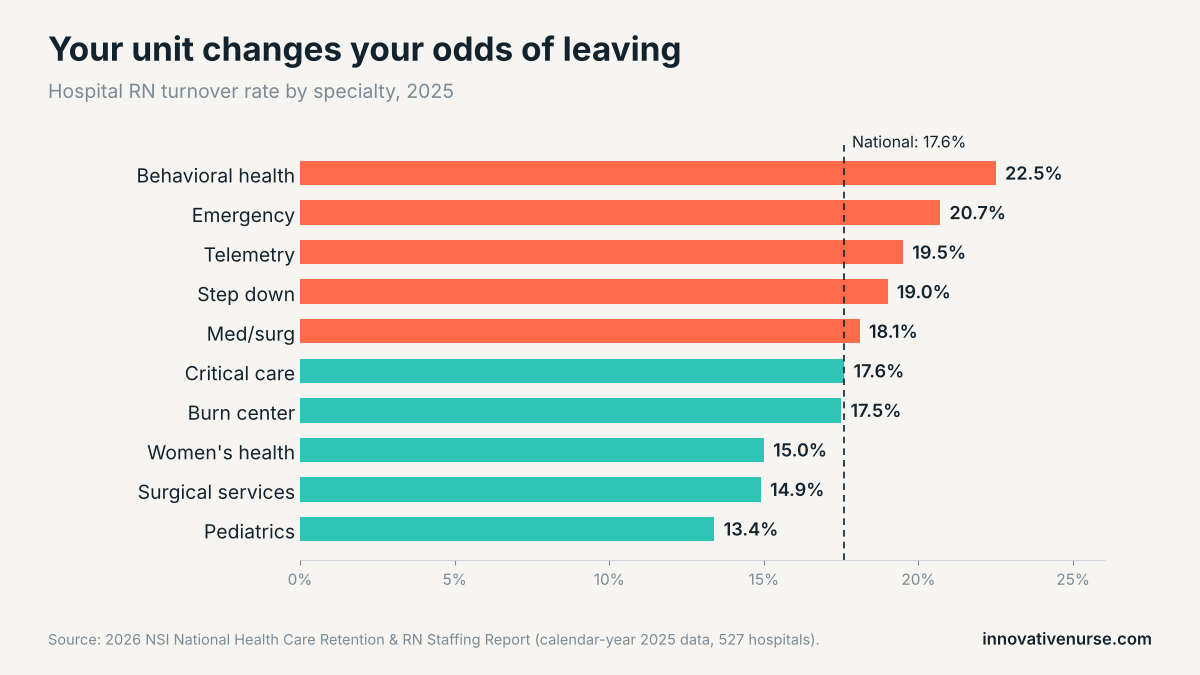
This is more common than it feels, because units are not created equal. In the 2026 NSI National Health Care Retention & RN Staffing Report, hospital RN turnover in 2025 ranged from 13.4% in pediatrics to 22.5% in behavioral health. Emergency, telemetry, step down and med/surg all ran above the 17.6% national average. Over the past five years, telemetry, step down and emergency departments each turned over more than their entire RN staff.
The solution: an internal transfer. Same employer, same benefits, often the same pay scale and seniority. If you’ve been eyeing a different specialty, read our breakdown of how your specialty shapes your salary first, because a unit change can also be a raise.
Cost to try: low and often accessible. Weeks, not months. Ask HR whether your step, PTO balance and seniority date carry over before you apply.
Box 2: The wrong employer
Sounds like: “This place doesn’t care about us.” Short staffing as policy, mandatory overtime, a pay scale that’s fallen behind the market, leadership that answers every concern with a pizza party or a $10 gift card.
The tell: the complaints follow the building, not the unit. Nurses on other floors say the same things you do. Here’s the cleanest test: would you do your exact job, on the same type of unit, across town, at market pay? If the answer is an instant yes, you don’t hate nursing. You’re just not with the right employer.
The NSI report’s list of why hospital employees resign backs this up. After personal reasons, relocation, career advancement, retirement and education, the top ten rounds out with scheduling conflicts, salary, commute, culture, and workload or staffing ratios. Nearly every item on that back half is an employer problem, not a profession problem. (That list covers all hospital employees, not only RNs, but the pattern is hard to miss.)
The solution: same specialty, different employer. And remember you have leverage here: as we covered in why hospitals lose nurses to math, replacing one bedside RN costs the average hospital $60,090.
Cost to try: moderate. Hospitals report it takes them about 78 days to recruit an experienced RN, so plan on a search of a couple of months. Watch for a step reset on the new pay scale, retirement vesting you’d forfeit, and any sign-on or tuition clawbacks. Our cost-of-staying worksheet walks through pricing each of those.
Box 3: The wrong setting
Sounds like: “I love my patients. I can’t do twelves anymore.” Nights, weekends, holidays, the acuity, the physical toll, never sitting down.
The tell: you still like the clinical work. Picture a Monday-to-Friday, eight-hour version of your job. If your shoulders drop, it’s the setting.
This is the box with the biggest money swing, in both directions. Federal wage data shows the same RN license paying very differently depending on where you use it:
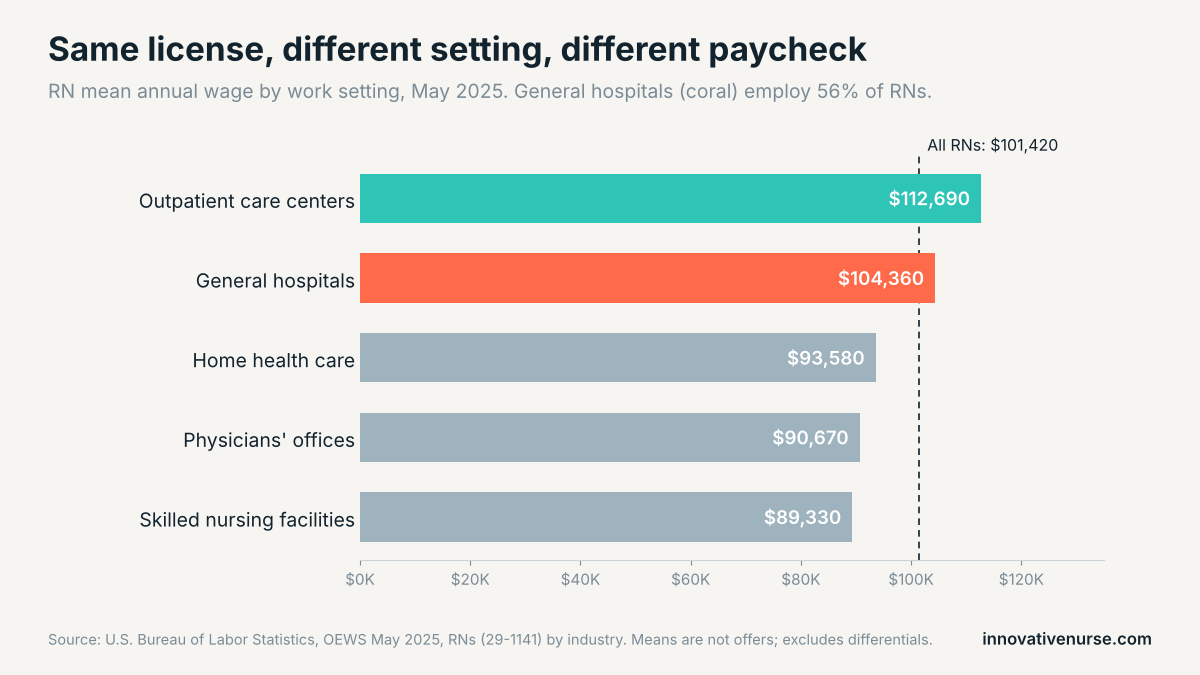
- Outpatient care centers: $112,690, about $8,300 above general hospitals
- General medical and surgical hospitals: $104,360
- Home health care: $93,580, about $10,800 below hospitals
- Physicians’ offices: $90,670, about $13,700 below hospitals
- Skilled nursing facilities: $89,330, about $15,000 below hospitals
That’s a $23,360 spread in mean pay between the top and bottom settings on this list. And those figures leave out shift differentials. If you’re living on night and weekend premiums right now, a “same pay” day job can be a real cut. Price the differentials you’d lose before you compare offers.
The solution: ambulatory, outpatient, procedural, home health, clinic, public health or school nursing. Our guide to where nurses go when they leave the bedside covers the options and what each one pays.
Cost to try: a few weeks to a few months, depending on whether the new setting wants specific experience.
Box 4: The wrong profession
Sounds like: “Even on a good day, I don’t want to be doing this.”
The tell: picture your best possible shift. Full staffing, a great charge nurse, stable patients, and you clock out on time. If you still don’t want to be there, this isn’t burnout from circumstances. It’s a mismatch with the work itself.
That’s a legitimate answer. It’s also the most expensive one, which is why it should be the box you land in last, not first.
The solution: a role that still uses your license without bedside care (case management, informatics, education, leadership, pharma patient support), or a full career change. Before you resign, run through our exit checklist so your license, money and references are protected.
Cost to try: the highest. Six months to two years, possible retraining, and a possible pay reset.
The 10-minute diagnostic
Open the notes app on your phone. This works better on a day off than in the car after a bad shift.
Step 1: Write down your last five bad shifts
One line each: what made it bad? Be specific. “Short staffed” is vague. “Two nurses called out and nobody was floated in” is useful.
Step 2: Tag each line U, E, S or P
- U (unit): it’s about this unit’s acuity, culture, manager or patient population.
- E (employer): it’s about pay, staffing policy, leadership or rules that apply hospital-wide.
- S (setting): it’s about the hours, nights, weekends, physical toll or pace of acute care.
- P (profession): it’s about patient care itself, no matter where or when.
Step 3: Answer four tiebreakers
- If you kept this unit but got a different manager, would most of it go away? That points to U.
- Do nurses on other units at your hospital complain about the same things? That points to E.
- Would a Monday-to-Friday version of this exact job fix it? That points to S.
- On your best possible shift, do you still not want to be there? That points to P.
Step 4: Read your tags
The letter that shows up most is your first move. If there’s a tie, start with the cheaper box. One rule overrides everything: if money shows up in more than one line, run your numbers before you do anything else. Pay problems hide inside all four boxes.
Fix the cheapest box first
Here’s the order of operations, from cheapest to most expensive:
- Unit: internal transfer. Weeks. Usually keeps your pay, PTO and seniority.
- Employer: same job, new employer. A couple of months. Watch for step resets, vesting and clawbacks.
- Setting: same license, new setting. Weeks to months. Mean pay ranges from about $15,000 less to $8,000 more than hospitals, before differentials.
- Profession: new role or new career. Six months to two years. Highest cost, highest uncertainty.
Trying a cheaper fix first isn’t settling. It’s a 90-day experiment. If the transfer doesn’t fix it, you’ve lost very little and learned which box you’re really in. If you jump straight to box four and the real problem was box one, that’s a lot harder to undo.
Scripts for each box
Unit (to your manager, or the manager of the unit you want):
“I want to stay in this system long term, and I’ve realized [current unit] isn’t the right fit for me. I’d like to transfer to [target unit] in the next 90 days. What do I need to do to make that happen, and will my step and PTO carry over?”
Employer (in the interview, when they ask if you have questions):
“What was RN turnover on this unit over the last 12 months, and what does a typical assignment look like on a short-staffed shift?”
If they can’t or won’t answer, that is your answer.
Setting (to the recruiter, before you interview):
“Can you share the pay range for this role, and does it include any shift or weekend differentials? I’m comparing against my current total hourly, not my base rate.”
Profession (to yourself, written down with a date):
“If I still feel this way after a transfer or a setting change, I’ll start a six-month plan to move into [role] by [date].”
Run the numbers before you decide
Once you know your box, put a price on it. The Stay-or-Pivot calculator compares your true current hourly, differentials included, against the move you’re considering, over the schedule you’d actually work. It’s the fastest way to see whether a setting change is a raise or a quiet pay cut, and whether staying is costing you more than leaving.
Name the box
Most of the nurses in those videos didn’t hate nursing. They hated one box, and nobody helped them figure out which one. You get to be more precise than that.
Name the box. Fix the cheapest version first. And if it really is the profession, leave on purpose, with a plan and your numbers in hand. That’s what refusing the status quo actually looks like.
Methodology & sources
- Intent to leave and setting changes: NCSBN, The 2024 National Nursing Workforce Survey (Smiley et al., Journal of Nursing Regulation, 2025). Data collected March 25 to December 31, 2024.
- Turnover by specialty, five-year cumulative turnover, reasons for resignation, recruitment time and replacement cost: NSI Nursing Solutions, 2026 National Health Care Retention & RN Staffing Report (calendar-year 2025 data, 527 hospitals in 40 states). Reasons for resignation cover all hospital employees, not RNs only. Accessed November 23, 2026.
- Wages by setting: U.S. Bureau of Labor Statistics, Occupational Employment and Wage Statistics (OEWS), May 2025 national industry-specific estimates for registered nurses (29-1141): general medical and surgical hospitals (NAICS 622100), outpatient care centers (621400), home health care services (621600), offices of physicians (621100) and nursing care facilities (623100). All-RN national mean: $101,420. Accessed November 23, 2026.
Caveats:
- Means are not offers. National figures hide large state and metro spread.
- OEWS wages exclude shift differentials and overtime pay, which is why differentials need to be priced separately.
- Turnover rates are hospital-reported averages. Your unit may run well above or below them.
- Timelines and costs for each box are general guidance, not survey results.
- Instagram discussion is characterized in aggregate. No posts are quoted and no creators are named.
- This is not legal or financial advice. Check your employment agreement before you resign.