
This is me telling you that if you want a nursing career beyond the bedside, there are opportunities out there. Out of my 20+ year career as a nurse, only two of those years were spent at the bedside in an ICU. It was an amazing experience that set the foundation for more of a consultative role ever since. Yes, several of those years were spent building a business in the healthcare and human services space, but since that exit I’ve been a consultant (a W-2 employee) for the last several years providing support to a pediatric population and providing families the education and resources for them to access care.
It’s quite nuanced and worth its own post, but it’s just one of the many sub-specialties that exist outside of a day-to-day clinical setting. But, I wanted to summarize something I found.
This week, one of the most active discussions in the largest online nursing community was the same one that tops the charts every few months: former bedside nurses describing where they went, and current bedside nurses asking how to follow. Hundreds of replies. It out-engaged nearly everything else on the board.
That’s not a trend. That’s a queue.
Nobody needs another listicle of “15 non-bedside nursing jobs” written by someone who’s never held a med pass. What you need is what the people in that thread were actually asking for: which paths are real, what they pay, and what they cost to enter. We’ve covered how to hunt for jobs beyond the bedside before; this is the data-driven follow-up.
Leaving isn’t one decision. It’s three trades.
Every exit path trades on three axes:
- Pay. Some paths out-earn the bedside. Several don’t. Knowing which is which before you apply is the whole game.
- Schedule. Most non-bedside roles are Monday-to-Friday days. That’s worth real money, and you should price it like money.
- Entry cost. Some paths take a well-written resume. Others take a certification, a degree, or two years of positioning.
Rank those three for yourself before reading the numbers. A $12K pay cut means one thing if you’re drowning in childcare-hostile scheduling, and another thing entirely if pay is the reason you’re leaving.
The real destinations (and the numbers)
The wage figures below are federal data: BLS Occupational Employment and Wage Statistics (OEWS), May 2025 national means unless noted. Means are not offers. Full caveats at the bottom.
1. Case management and utilization review
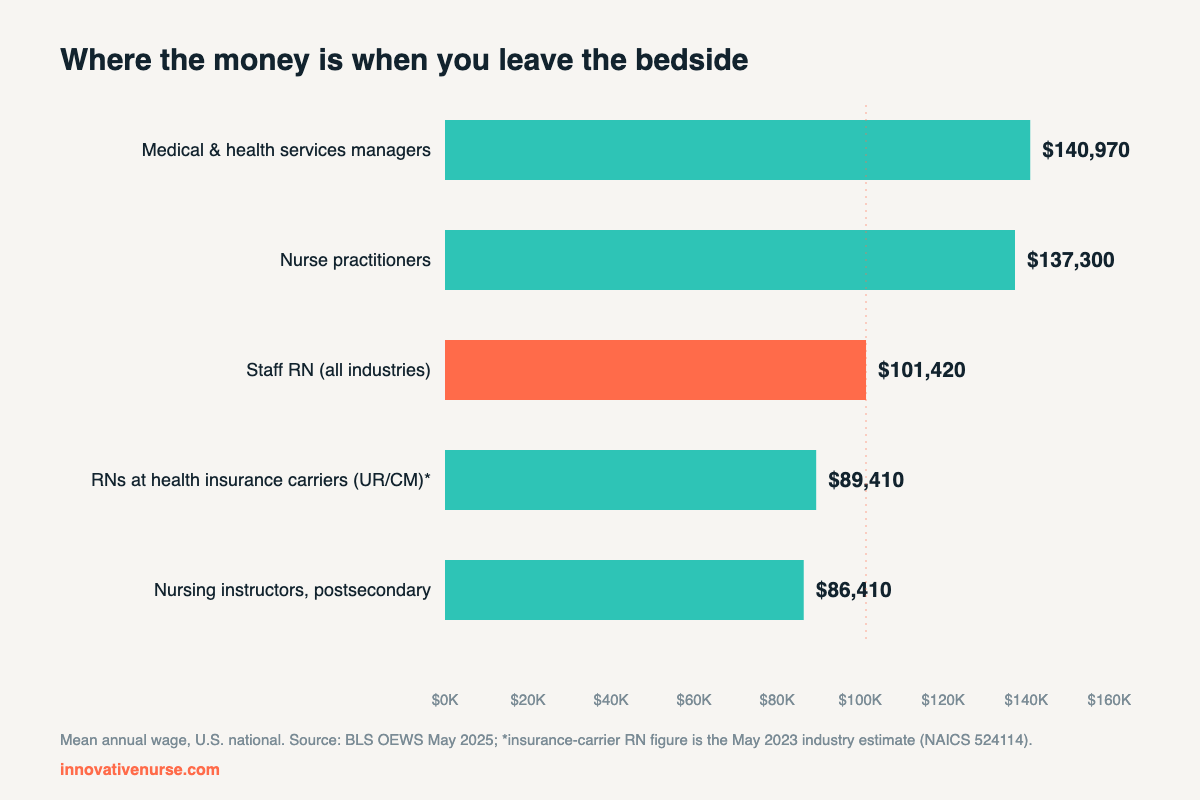
The classic first step off the unit, because it hires directly from bedside experience. Hospital case management usually keeps you on an RN pay scale. Payer-side UR moves you to an insurance company. In the most recent industry-level federal data (May 2023), RNs employed by health and medical insurance carriers averaged $89,410, a bit under the all-industry RN average from the same period. Translation: expect roughly bedside-average pay, minus differentials, plus weekends and holidays back.
2. Informatics and clinical systems
The EHR you complain about was configured by someone, and that someone is increasingly a nurse. There’s no clean federal wage line for nurse informaticists, but the HIMSS Nursing Informatics Workforce Survey (2022, the most recent published cycle) found 60% earning over $100,000, a share that has climbed every survey since 2014. Epic or Cerner credentialing, super-user experience, or an informatics certificate is the usual door.
3. Education
The honest one: academic nursing instructors averaged $86,410 (OEWS May 2025), about $15,000 under the staff-RN average. Faculty pay is a known structural problem, and it’s why schools can’t hire and your unit can’t get students. Clinical education roles inside hospital systems often pay closer to RN scale than academia does. Go for love, but go with your eyes open.
4. Leadership and administration
The biggest upside on the board: medical and health services managers averaged $140,970 (OEWS May 2025), roughly $40K above the staff-RN average. The catch is the ladder usually runs through charge and manager roles you may be trying to escape, and the exposure is real (you become the person the unit rants about). Highest ceiling, longest climb.
5. Ambulatory, periop, and clinic roles
Not technically an exit, but for a lot of nurses it’s the right answer: same license, same pay class, human hours. If your problem is nights, weekends, and codes rather than nursing itself, this lane costs nothing to enter and keeps your clinical skills liquid.
6. Pharma, PBM, and specialty pharmacy patient support
Here’s the lane most exit lists miss because the job titles don’t say “nursing”: pharmaceutical companies, pharmacy benefit managers, and specialty pharmacies hire nurses to run patient education and care coordination for people on complex therapies. CVS Caremark’s specialty care teams, for example, are built around nurses trained in specific conditions who manage side effects, coordinate with prescribers, and coach patients through treatment. These are salaried clinical roles with business-world hours, and your bedside experience is exactly the credential they’re screening for. Most large payers and specialty pharmacies run some version of this model.
The wildcard lane
Pharma and device sales, legal nurse consulting, aesthetics, health tech. Real money is possible and no federal statistic describes it honestly, because pay is commission-heavy and variance is enormous. Treat any salary figure you see for these as marketing until someone shows you an offer letter.
Here’s one more offering and I have personally vetted these myself: plenty of corporate healthcare roles never advertise for nurses but will happily hire one. DaVita is a good example; some of its non-clinical leadership postings don’t mention nursing in the title, then state in the job description that clinical backgrounds like nursing are considered. The title won’t say RN. The description will. So stop searching job boards by “nurse” and start searching by your skills: “clinical background,” “RN preferred,” “patient education,” “care coordination.” The roles that don’t market to nurses often have the least competition from them.
What each path costs to enter
- Case management / UR: resume reframe plus CCM certification later. Weeks to months.
- Informatics: super-user role now, vendor certification when the system pays for it. Months to a year.
- Education: MSN usually required for academia; hospital educator roles sometimes take a BSN plus experience. A year or more. Use tuition reimbursement before you resign, not after.
- Leadership: charge experience, then a formal role. Often an MSN/MBA on the employer’s dime. Years, by design.
- Ambulatory/periop: a transfer application. Days.
Scripts that open doors
The internal-transfer ask (to your manager, before HR sees an application): “I want to stay in this system long-term, and the role I’m building toward is [X]. What would you need to see from me in the next six months to support that move?”
The resume reframe (bedside to non-clinical): don’t list tasks, list systems. “Managed care coordination for 6-patient assignments across a 32-bed unit” reads as case management. “Unit super-user for Epic upgrade, trained 40 staff” reads as informatics. You already did the job; the resume just has to say so in the destination’s language.
The interview line for the inevitable “why are you leaving the bedside?”: “I’m not leaving nursing. I’m moving to the part of nursing where I can fix the problems I’ve been working around for [N] years.”
Run the math before you jump
Here’s the trap in every exit story you read online: nobody posts their differentials. A Monday-to-Friday job at “the same pay” can be a real pay cut once night, weekend, and holiday premiums disappear, and a small raise can be a big one once you price in schedule sanity. That’s exactly the calculation the Stay-or-Pivot calculator runs: your true current hourly including differentials, against the offer, priced over the schedule you’d actually work. Run your numbers before you write the resignation letter, not after.
Methodology & sources
Wage figures are national mean annual wages from the U.S. Bureau of Labor Statistics, Occupational Employment and Wage Statistics (OEWS) program, May 2025 reference period (published 2026): registered nurses (29-1141) $101,420; medical and health services managers (11-9111) $140,970; nursing instructors and teachers, postsecondary (25-1072) $86,410; nurse practitioners (29-1171) $137,300. The insurance-carrier RN figure ($89,410) is from the OEWS May 2023 industry estimate for direct health and medical insurance carriers (NAICS 524114), the most recent industry-level cut cited here; it is not directly comparable to the May 2025 national figures. Nurse informaticist salary distribution is from the HIMSS Nursing Informatics Workforce Survey (2022 cycle).
Caveats: means are not offers; national figures hide large state and metro spread; OEWS classifies most case management, UR, and informatics nurses under the general RN code, so those specialty figures rely on industry cuts and association surveys; commission-based industry roles have no reliable public wage data. Community discussion referenced in the introduction is characterized in aggregate; no forum content is reproduced.