
You found out in a town hall, or in a community email full of phrases like “market alignment” and “sustainable compensation.” This likely landed pretty hard because the math is the same: same job, same patients, less money. Nurses across the Southeast are comparing notes on exactly this right now, and the anger is earned.
You can feel salty, but then get organized. A pay cut is not just an insult. It’s information: your employer just told you, in writing, what they think you’ll accept. The next 30 days are your window to answer with data instead of a resignation text. Here’s the plan.
Days 1–7: Pin down the real number
“Compensation adjustment” is doing a lot of work in that email. Your first job is to convert vague language into an exact dollar figure. Get answers, in writing, to five questions:
- Does the cut touch base pay, differentials, or both?
- Are night, weekend, and charge differentials changing? Cuts love to hide there.
- Is the incentive or critical-staffing shift rate changing or disappearing?
- Does it affect your clinical ladder placement or scheduled step increases?
- When exactly does it take effect, and does your handbook or contract require advance notice?
Script for HR (email, never hallway): “I’d like written confirmation of how the announced compensation change affects my base rate, my differentials, and my scheduled increases, along with the effective date, so my records are accurate.” That’s it. Polite, specific, paper trail. Note that many states require advance written notice before a wage reduction, and a cut can’t apply to hours you’ve already worked. Check your state’s rules.
Days 8–14: Run the market math
Now find out what the cut actually costs, because “5%” sounds small and $70,000 doesn’t. Say you earn $90,000. A 5% cut is $4,500 a year, about $2.16 an hour. But the real damage is the gap that opens over time. State-level RN wages grew a median of 3.4% last year. If the market keeps moving and your pay stays at the cut level:
| Timeframe | Your pay (5% cut, flat) | Market pay (3.4%/yr growth) | Cumulative gap |
|---|---|---|---|
| Year 1 | $85,500 | $93,060 | $7,560 |
| Year 5 | $85,500 | $106,376 | ~$70,500 |
| Year 10 | $85,500 | $125,733 | ~$231,700 |
Your numbers will differ. That’s the point: run them. And know where your rate already sits against the market:
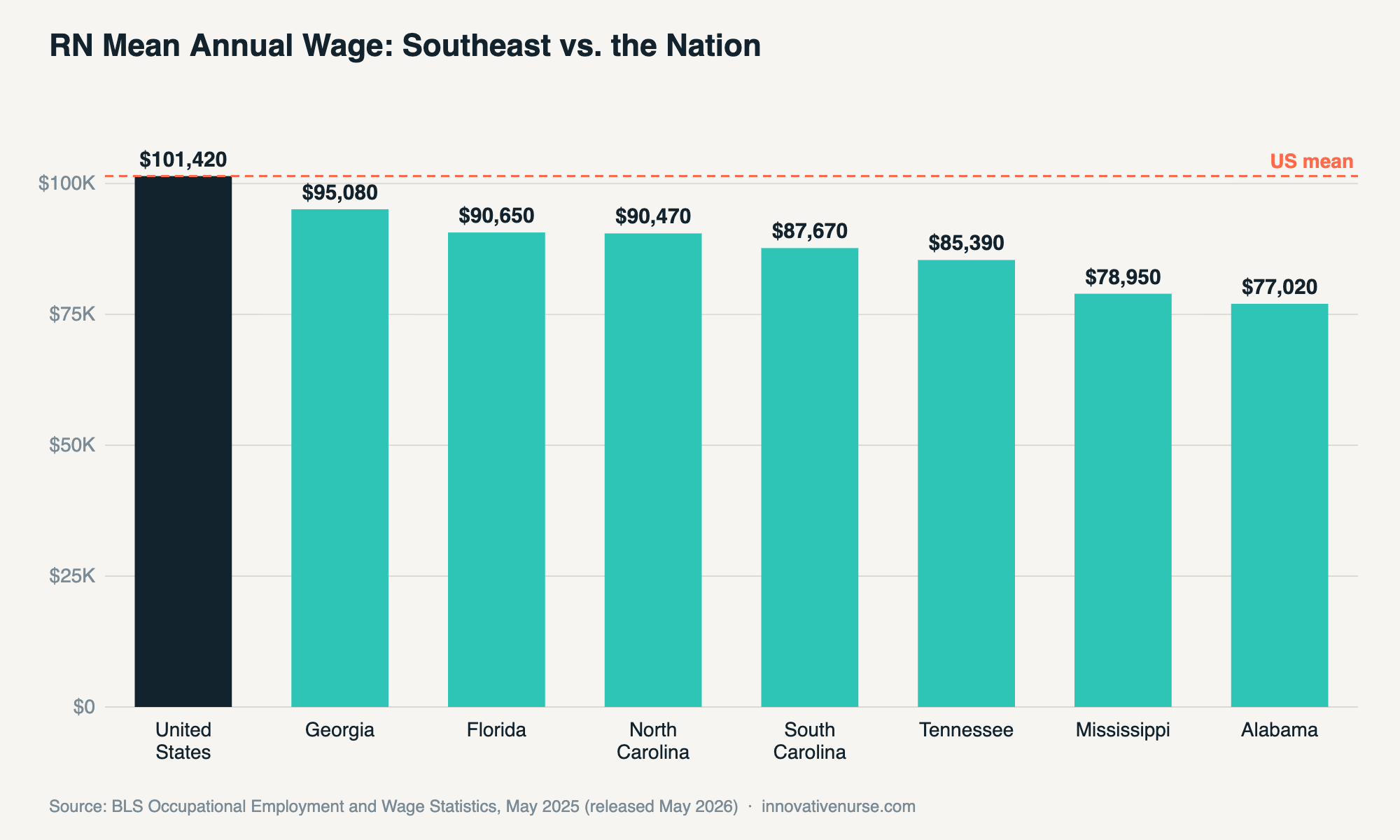
Every Southeast state already sits below the national mean of $101,420, which makes absorbing a cut there doubly expensive. For the full picture of what nurses earn, see What Nurses Actually Make in 2026, and for what those dollars buy in your metro, The $140K Mirage.
Then check your actual local market: three current postings for comparable roles within driving distance beat any national table. Screenshots, dates, and numbers go in a spreadsheet. You’re building an exhibit, not a mood.
Days 15–21: Test your leverage where you are
A cut announcement is also a negotiation opening, even when it’s framed as final. Leadership models attrition into every one of these decisions, and retention is suddenly their problem. Three moves:
- Ask the direct question. “I’d like to stay. Is there flexibility on differentials, ladder placement, or scheduled increases for staff you want to keep? Show me how the numbers work.”
- Reprice yourself internally. Units with higher differentials, procedural areas, and float premiums can offset a base cut without changing employers.
- Price a certification. Many systems pay differentials for CCRN, CEN, and similar credentials. A $2/hr cert differential neutralizes the example cut above.
If the answer to everything is no, that’s not failure. That’s data for week four.
Days 22–30: Decide from strength
By day 22 you have the exact cut in writing, the market gap in dollars, and your employer’s real flexibility on record. That leaves three legitimate options: stay on a plan with dates attached (cert by spring, transfer window noted, re-evaluate at six months), pivot internally, or leave on your terms. Leaving well is its own skill; the exit checklist covers protecting your license and your money on the way out, and this guide covers where nurses actually land.
Whichever way you lean, run your numbers through the Stay-or-Pivot calculator. It turns the salary gap, the differentials, and the cost of a move into one comparison you can act on.
The status quo response to a pay cut is to grumble and absorb it. You’re not the status quo. Thirty days, five emails, one spreadsheet, and a decision made with numbers instead of fear.
Methodology & sources
- Wage figures: BLS Occupational Employment and Wage Statistics, May 2025 estimates (released May 15, 2026). National RN mean annual wage $101,420; state means as charted.
- Wage growth: median state-level change in RN mean wage between the May 2024 and May 2025 OEWS releases, +3.4% (nominal).
- Cut-cost projections: our calculations on a $90,000 illustrative base; the market path grows 3.4% annually while the cut path stays flat.
- Caveats: means are not offers; statewide figures hide metro spread; all figures are nominal, not cost-of-living adjusted; wage-notice rules vary by state, and nothing here is legal or financial advice.