
You’re not burned out because you can’t handle it. You’re tired because you’ve been asked to do more with less for so long that “more with less” became the job description.
Hospitals love to talk about resilience. Yoga rooms. Wellness emails. A pizza party. Meanwhile the thing that actually decides whether you stay or go is sitting in a spreadsheet you’ve never seen. It’s a math problem, and the hospital has already run the numbers. Here they are, so you can run yours.
The number your employer doesn’t say out loud
According to the 2026 NSI National Health Care Retention & RN Staffing Report, replacing one bedside RN costs the average hospital $60,090. National RN turnover sits at 17.6%, and each percentage point of turnover costs the average hospital about $295,000 a year. Filling an experienced RN seat takes roughly 56 to 102 days (sources at the bottom: Becker’s Hospital Review and Nurse.org).
Read that again. The hospital will spend more than sixty grand to lose you, then spend it again to replace you, and still call a raise “not in the budget.”
Run the math the way HR does
Here’s the comparison your manager would never put on a slide. These figures are my own back-of-the-envelope math using the NSI average, so treat them as illustrations, not offers.
- $60,090 is what one departure costs the average hospital.
- A $5/hour raise for one full-time nurse costs about $10,400 a year (5 x 2,080 hours). The cost of losing you covers that raise for nearly six years.
- A $10/hour raise costs about $20,800 a year. The cost of losing you covers it for nearly three years.
- At about $295,000 per turnover point, one point of turnover costs roughly what it takes to replace five nurses.
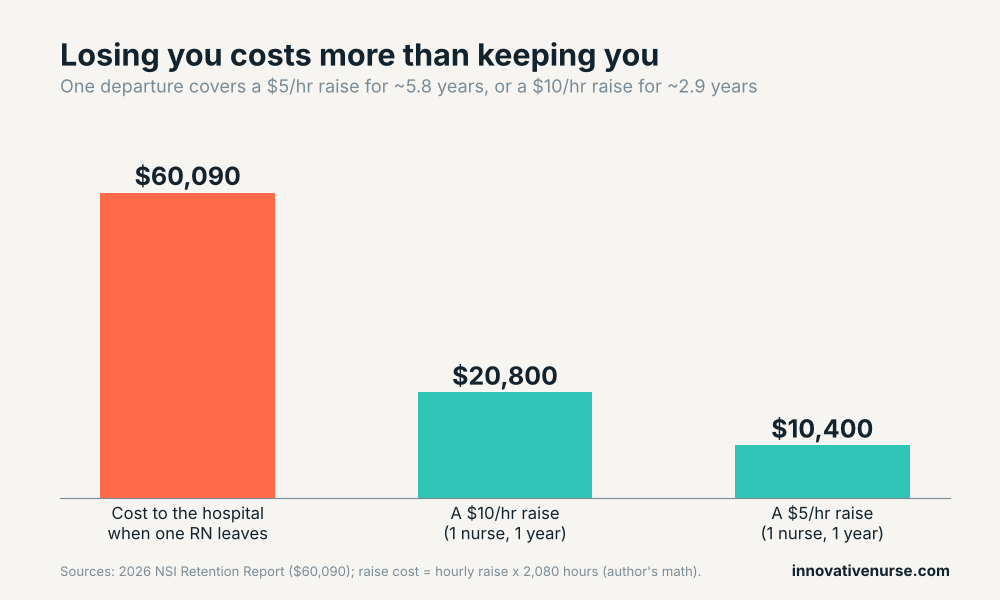
That’s not a guarantee anyone will pay you more. It’s leverage in your negotiation. You know what your exit costs them. And they know too. But who’s going to say it first?
A different lens: this isn’t “stay or suffer.” It’s a decision.
When the vent is “I can’t keep doing this,” the useful question isn’t “am I weak?” It’s “what’s the best move given what staying is costing me?” You have four real options:
- Fix it where you are. Negotiate pay, schedule, or assignment. Works best when the unit is salvageable and leadership listens.
- Change the unit. Float pool, a different specialty, or a different shift. Same employer, different math.
- Change the employer. Same job, better ratios, better pay, fewer broken promises (hopefully).
- Change the role. Off the floor entirely, which is a bigger move that deserves a runway first.
Not sure which one fits? Put your actual numbers into the Stay-or-Pivot calculator before you decide. And if you’re leaning toward the door, read Everyone Asks Why You Left. Nobody Asks What Staying Cost. and the exit checklist that protects your license, your money, and your next job.
Your 15-minute diagnostic
Score each one yes or no. Three or more “yes” answers means the problem is the system, not you.
- My assignment is regularly above what I’d call safe, and it’s treated as normal.
- We’ve lost more than a couple of experienced nurses on my unit in the past year, and the seats stay empty or get filled with churn.
- I’ve been told a raise or schedule change “isn’t possible” without anyone showing me why.
- I’m picking up extra shifts to cover gaps, not because I want the money.
- I dread the start of every shift, not just the bad ones.
- A comparable unit or employer in my area pays more or staffs better.
The script: how to open the conversation
Don’t open with a threat. Open with a business case. Try this, adjusted to your voice:
“I want to keep working here and I want to be honest about what it would take. I’ve looked at what turnover costs the organization and at what comparable roles pay in our market. I’d like to talk about [a pay adjustment / a schedule change / a different assignment] so I can stay long term. Can we set up time this week?”
Bring three things: your current pay and differentials, one or two verified market comparisons (use BLS OEWS wage data for your area and specialty), and the specific change you’re asking for. Leave the emotion at the door and bring the data.
What to do if the answer is no
- Ask what the path to yes looks like and when you’ll hear back, in writing.
- Start a quiet search. Apply, interview, and learn your market value without a deadline.
- Protect your runway: know how many months of expenses you have saved before you make any move.
- Document your workload through the proper channels so your decision rests on facts, not just how you felt on a bad week.
The bottom line
Burnout is real and it’s personal. It’s also predictable, measurable, and expensive for the people who cause it. When you understand the math, you stop asking whether you’re tough enough and start asking whether they’re paying enough. That’s not complaining. That’s leverage.
Want this kind of math in your inbox every week? Join the Career Leverage Newsletter and keep building your options.
Methodology & sources
- 2026 NSI National Health Care Retention & RN Staffing Report (2025 data), as summarized by Becker’s Hospital Review and Nurse.org: $60,090 average cost per bedside RN turnover, 17.6% national RN turnover, about $295,000 per year per percentage point for the average hospital, 56 to 102 days to fill an experienced RN role.
- Wage comparisons: BLS Occupational Employment and Wage Statistics.
- Raise math is the author’s own illustration: hourly raise x 2,080 hours (full-time year), compared with the $60,090 NSI average.
- Caveats: NSI figures are national hospital averages and your facility will differ. NSI changed how it calculates vacancy, so year-over-year vacancy comparisons aren’t clean. Means are not offers, and a raise isn’t guaranteed. This is general career information, not legal or financial advice.