
I know this has been in your feeds. A nurse says he/she makes $2,000 a month in 20 minutes a day. A carousel lists “remote nursing roles” with $100K+ stamped on every one. Another nurse says attorneys will pay you $150 an hour to read/audit charts. Then the punchline: comment GUIDE, which you then receive a DM with more information.
You shouldn’t feel guilty. Wanting a second income isn’t greed. You’re already doing the math on whether one paycheck is enough, and a lot of nurses are coming up short. The itch isn’t the problem. The problem is that most of the numbers in your feed come attached to something for sale. I realize the work that goes into developing a detailed guide or course shouldn’t be monetized because just as much as your time is valuable, so is that individual’s time that made this investment to create it.
So we checked them against the data. And for those of you taking a more clinical approach to your side journey, here’s what the common nurse side gigs actually pay, how to turn any posted rate into what you’d really keep, and a checklist for vetting the next claim before you hand over your email address.
Start with the claim’s own math
“20 minutes a day for $2,000 a month” sounds modest. Run it: 20 minutes a day for 30 days is 10 hours. $2,000 divided by 10 hours is $200 an hour.
The median registered nurse earns $46.90 an hour, according to the latest federal wage data. That claim implies more than four times that, for work pitched as the easiest hustle out there. Even legal nurse consulting, the consultant role most often sold with a $150 figure, has a reported median of $57.42 an hour. $150 is roughly where the 90th percentile sits, and likely where a nurse has turned this into a full-time endeavor as an agency.
That doesn’t mean nobody earns it. It means the person showing you the number is the outlier, and the outlier is usually selling the course.
Sort every claim into three buckets
- Verifiable. There’s a job posting, a staffing platform or federal wage data with the rate on it. PRN shifts, health education roles and remote utilization review jobs mostly land here.
- Plausible but variable. Real work and real clients, but the rate depends on your niche, your marketing and how many hours you can actually fill. Legal nurse consulting, tutoring, freelance health writing and CPR instruction live here.
- Funnel bait. The rate has no source, the hours are vague, and the post ends with “comment GUIDE” or a link to a paid program. Treat it as an ad, because it is one.
What the gigs actually pay
Here’s the typical hourly rate for the side hustles that show up most often, where the number comes from, and what stands between you and the first dollar.
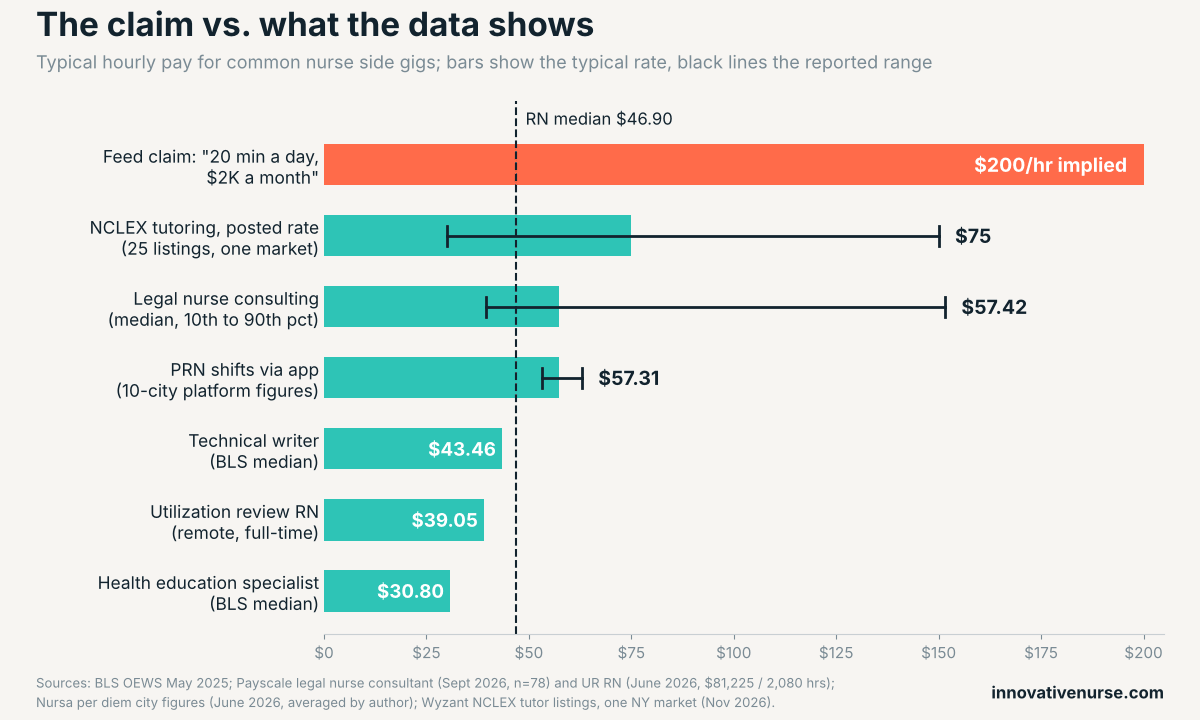
| Gig | Typical rate | Reported range | How you’re paid | The catch |
|---|---|---|---|---|
| PRN shifts via a staffing app | ~$57/hr (10-city average) | $53 to $63 | Varies by platform; check W-2 vs. 1099 | Platform-reported; no benefits; shifts can cancel |
| Legal nurse consulting | $57.42/hr median | $39.65 to $151.55 | Per case, 1099 | You find the clients. The LNCC credential requires 2,000 hours of LNC work first; the exam runs $360 to $495 |
| NCLEX tutoring (marketplace) | $75/hr posted median | $30 to $150 | 1099 | The platform keeps 25% unless you bring the student |
| Technical or health writing | $43.46/hr (BLS median) | n/a | Salaried or per project | BLS number is for employees; freelance work is priced per project |
| Utilization review RN (remote) | ~$39/hr ($81,225/yr) | $65K to $97K/yr | W-2, full-time | It’s a job change, not a side gig |
| Health education specialist | $30.80/hr (BLS median) | n/a | Usually W-2 | Pays below the RN median; best as a bridge |
| CPR/BLS instructor | No reliable public data | n/a | Per class | Get per-class pay in writing before you pay to certify |
Notice the pattern: the gigs that beat your bedside rate are the ones where you have to find the customers. That’s not a reason to skip them. It’s a cost of entry you need to price in.
And that “$100K+ remote nursing roles” carousel? The typical utilization review nurse reports $81,225 a year. Solid, remote and a real option. Also not a side hustle. It’s a full-time pivot, and we broke down where bedside nurses actually land in Where Nurses Actually Go When They Leave the Bedside.
Turn any posted rate into your real hourly
A posted rate is the top of the funnel. Your effective hourly is what’s left after fees, taxes and the hours nobody pays you for. Here’s a $75-an-hour NCLEX tutoring rate run through it.
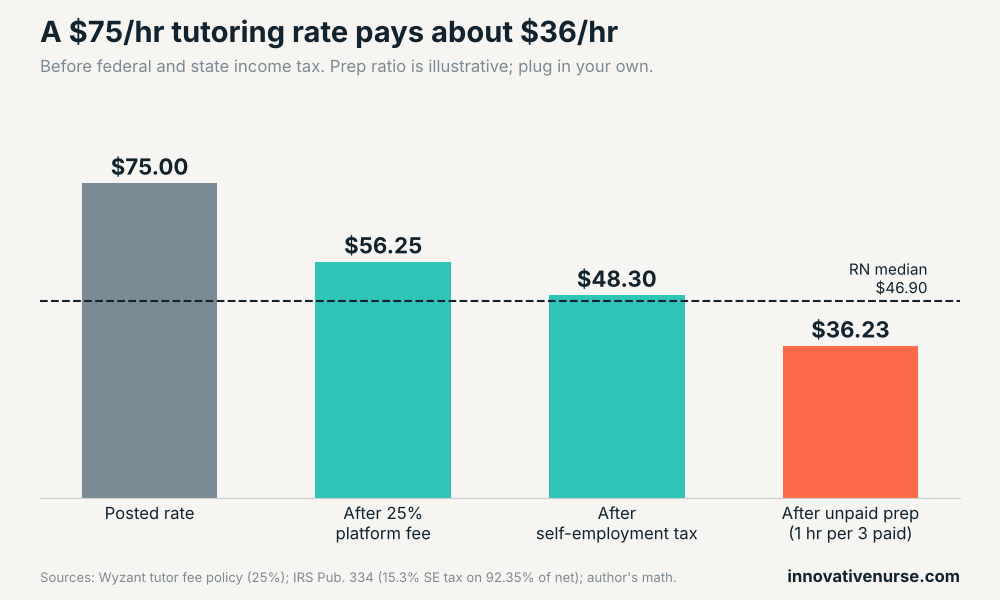
- Platform fee. Wyzant keeps 25% of your rate on students it sends you. $75 becomes $56.25.
- Self-employment tax. As a contractor you pay both halves of Social Security and Medicare: 15.3% on 92.35% of your net earnings. That’s about $7.95 an hour, leaving $48.30.
- Unpaid time. Prep, messages, scheduling, no-shows. If every 3 paid hours cost you 1 unpaid hour, your $48.30 is really spread over 4 hours: $36.23.
About $36 an hour, before income tax. The RN median is $46.90, and that W-2 number comes with an employer covering half your payroll taxes and, usually, benefits. A $75 rate can still be worth it. Just know what it pays before you build your schedule around it.
Copy this: the effective hourly formula
Effective hourly = (gross pay ? platform fees ? self-employment tax ? out-of-pocket costs) ÷ (paid hours + unpaid hours)
- Unpaid hours to count: finding clients, prep, admin and invoicing, travel, and any required CE or certification time.
- Costs to count: certification and exam fees, liability insurance, software, mileage and equipment.
The 7-question vetting checklist
Before you comment GUIDE, buy the course or give up your days off, ask:
- Is the number per hour, per project or per month? Convert it to per hour.
- How many hours does the claim assume? If it doesn’t say, assume more.
- Can you find a real job posting or wage survey with a similar rate?
- Who pays you: an employer (W-2), or clients you have to find yourself (1099)?
- What’s required before the first dollar? Certification, experience hours, insurance? (Legal nurse consulting’s LNCC, for example, requires 2,000 hours of consulting work before you can sit for the exam.)
- Is the person sharing the rate selling a course, cohort or guide? Then their income is the course, not the gig.
- Does your employer have a moonlighting or conflict-of-interest policy that covers this work?
The decision: hustle, extra shift, or skill?
Here’s your different lens. A side hustle isn’t a personality. It’s a rate decision. If a gig’s effective hourly lands below what you’d earn picking up a shift, you’re paying for flexibility. That can be worth it. Just make it a choice, not a surprise.
The strongest bets build a skill your day job can’t take away: chart review that grows into a consulting practice, teaching that leads to a faculty role, writing that becomes a remote career. The weakest bets are the ones whose main product is a course about doing it.
One thing I also want to be clear on, and should have prefaced is that I took those early, low hanging fruit opportunities that didn’t always pay the best, but it got me in the room. Once I established myself, my skillset, the value that I brought to the client/organization I was then able to scale up from there. It is possible to start and maintain a consulting business, it’s just not typically a financially lucrative endeavor from the jump. But once you establish yourself, maybe you even build a small team, these numbers can start to land in the ballpark of replacing your main income if this is your goal.
Still deciding whether a side hustle fits your life at all? Start with our earlier guide to side hustles and the gig economy.
We’ll keep vetting these claims as they hit your feed. Get the numbers, scripts and gig breakdowns every week in the Career Leverage Newsletter. It’s free, and nobody will ask you to comment GUIDE.
Never just the status quo.
Methodology & sources
- U.S. Bureau of Labor Statistics, Occupational Employment and Wage Statistics, May 2025, Table 1: median hourly wages for registered nurses ($46.90), technical writers ($43.46), health education specialists ($30.80). Accessed Nov. 16, 2026.
- Payscale, Legal Nurse Consultant hourly rate: median $57.42, 10th to 90th percentile $39.65 to $151.55 (78 profiles; updated Sept. 7, 2026).
- Payscale, Registered Nurse (RN), Utilization Review salary: average $81,225, range $65K to $97K (312 profiles; updated June 27, 2026). Hourly figure is $81,225 ÷ 2,080 hours.
- Nursa, RN per diem pay by city (updated June 2026). The ~$57 figure is an unweighted average of the 10 city rates, calculated by Innovative Nurse.
- Wyzant, posted rates for 25 NCLEX tutors in one New York market (captured Nov. 16, 2026) and tutor fee structure (25% platform fee).
- American Association of Legal Nurse Consultants, LNCC certification FAQs: 2026 exam fees ($360 members, $495 non-members) and eligibility.
- Internal Revenue Service, Publication 334 (2025), Tax Guide for Small Business: 15.3% self-employment tax rate.
Caveats
- Medians and averages aren’t offers. Your market, specialty and experience move the number.
- Payscale figures are self-reported with modest sample sizes. Nursa’s figures come from a staffing platform describing its own shifts.
- The Wyzant sample is 25 listings from one market on one day. A posted rate isn’t a booked hour.
- BLS rates for writers and health educators describe employees, not freelancers.
- The one-unpaid-hour-per-three-paid ratio is illustrative. Track your own for a month.
- A 1099 rate and a W-2 rate aren’t a perfect comparison: employees pay 7.65% in payroll taxes, but employers cover the other half and often add benefits. This isn’t tax advice.