
Why now
A major academic health system just moved premium shifts from a set bonus to a reverse auction. Based on staff descriptions circulating this week: the shift posts at roughly base pay plus a 30% premium, and the premium drops about 5% for every additional nurse who wants it. Lowest bid usually wins, though managers keep an override for skills and unit needs. The nurse reaction was loud, split, and revealing: half wanted collective refusal, half pointed out that one desperate coworker breaks any pact.
This is not one hospital’s experiment. Gig platforms like ShiftKey already run lowest-bid-wins marketplaces where nurses report bidding themselves below a living wage, and researchers have flagged the model as “Uber for nursing,” including concerns that platforms learn the minimum each individual nurse will accept. Reverse auctions moving inside hospital systems is the escalation.
First: the anger is correct
You spent years building a license, and now you are being asked to haggle against the nurse at the next station like it is a storage-unit auction. A bidding system converts your scarcity (there is a nursing shortage) into your problem (compete for the privilege of extra work). Name that clearly, then get strategic, because when you’re seething without a number, this is how people end up underbidding at 2am.
Reframe: this is a market, and markets can be read
A bidding system is the hospital showing you its hand. It tells you exactly what they think extra shifts are worth, how desperate they are, and how they expect nurses to behave. You cannot control the system, but you can control your floor, your information, and your participation. That is leverage.
The playbook: 6 moves
1. Set your floor rate before you ever open the app
Never decide your number while looking at a shift. Decide it once, in daylight, and write it down.
- Start with your overtime-equivalent rate: base hourly x 1.5. This is your reference point, because premium shifts historically paid at or above OT.
- Add your inconvenience premium: what an unplanned 12 actually costs you (childcare, recovery day, sleep disruption). For most nurses this is $5 to $15/hr on top.
- Subtract nothing. Taxes, “it all helps,” and guilt do not get a vote.
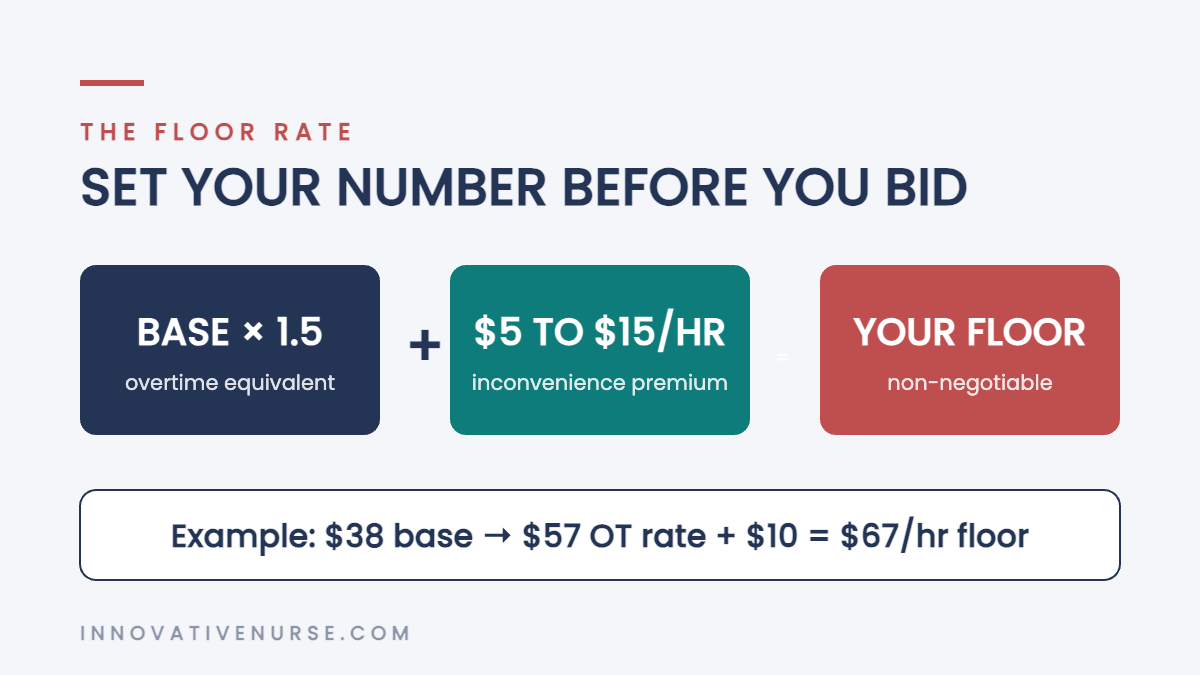
Example: $38 base x 1.5 = $57, plus $10 inconvenience = $67/hr floor. If the auction cannot reach it, the answer is no, every time, without a second thought.
2. Get the mechanics in writing
Before bidding once, get answers to five questions (email HR or your manager so the answers are documented):
- Is there a cap and a floor on the premium, and what are they?
- What triggers the premium to drop, and by how much?
- Does the manager override mean a lower bidder can lose? On what criteria?
- Does declining to bid affect scheduling, standing, or evaluations in any way?
- Is this limited to extra shifts, or can it expand to core scheduling?
The written answer to the last two questions is the one you will want later.
3. Talk about your number out loud
The system only drives pay down if nurses bid blind. Openly discussing pay with coworkers is legally protected activity for most private-sector employees in the US, and it is the single cheapest counter to an auction. (Public-sector rules vary by state, and some states restrict formal collective bargaining, so know your category before organizing anything formal.)
The play is simple: everyone knows the cap, everyone bids the cap, nobody bids under a shared floor. Nurses at one hospital reported that once this norm held, nobody undercut an existing bid and the system quietly died. Be honest about the weak point too: it only takes one underbidder, so the goal is norm-setting, not policing.
Script for the coworker conversation: “I’m treating the cap as the rate. If we all do, this stays a bonus system. If we bid each other down, the premium is gone in six months and it never comes back. What’s your floor?”
4. Let unfilled shifts do the talking
An unfilled shift at a low premium is the market answering the hospital. Filling it below your floor destroys the only data point working in nurses’ favor. If the auction stalls and the charge nurse starts calling, that phone call is your leverage returning.
Script for the manager conversation: “I’m glad to pick up when the rate reflects the ask. My number for an unplanned shift is X. When the system can get there, count me in.” Calm, specific, repeatable. No rant required.
5. Watch the expansion red flags
Auctions rarely stay contained. Screenshot this list:
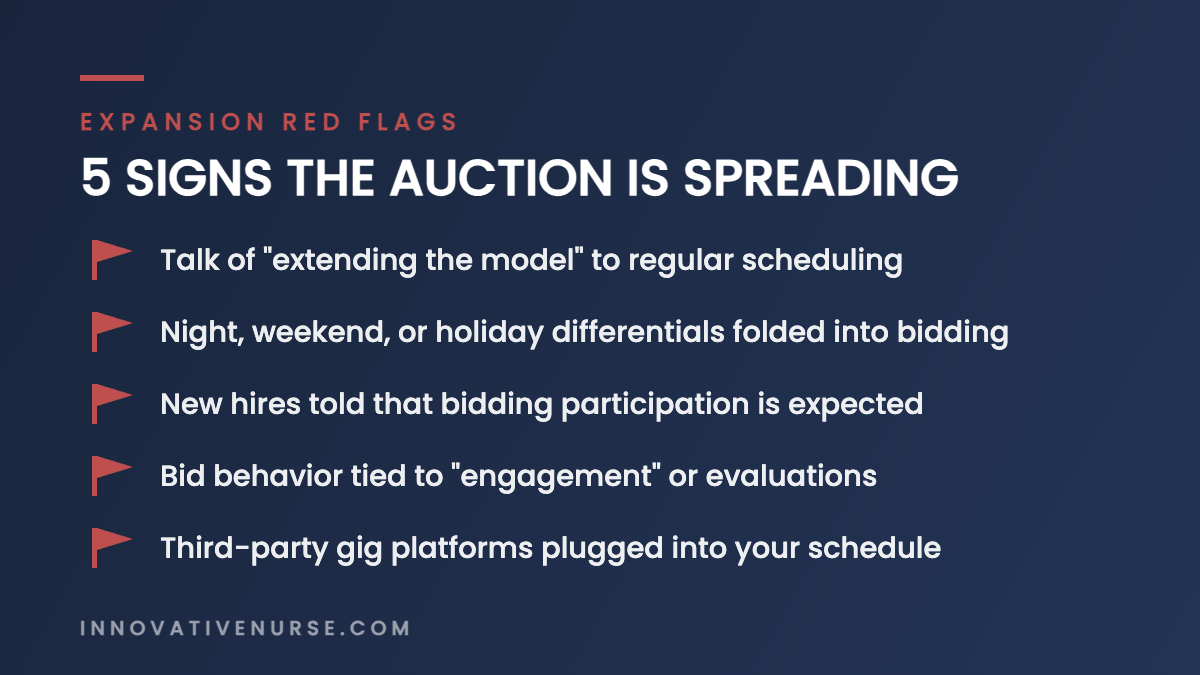
Any one of these changes the question from “should I pick up extra” to “should I still work here.”
6. Run the stay-or-pivot math
If premium pay was part of why the job penciled out, an auction system just cut your effective compensation, even if your base never moved. That is a comp change and deserves a comp-change response: rerun the numbers. Plug realistic post-auction extra-shift income into the Stay-or-Pivot calculator and see whether the job still beats the alternatives in your market.
The gig-app version of this is worse
In-house auctions at least sit on top of a W-2 job with benefits. On marketplace apps, reporting and research describe lowest bid wins dynamics, rating penalties for cancellations, no onboarding at unfamiliar facilities, and possible individualized pricing based on your data. If you are supplementing with app shifts, the same floor-rate discipline applies double, and the floor should be higher, not lower, because there are no benefits attached.
Hold your number
Your license is scarce. Auctions exist because that scarcity is expensive for hospitals. Hold your number, then run the calculator and decide with data, not exhaustion. For the scripts and numbers we publish every week, join the Career Leverage Newsletter.