
Ask a room full of nurses what they wish someone had told them before they picked their specialty, and you won’t get a room. You’ll get a roast. One of the biggest nursing threads on the internet this week was exactly that: hundreds of nurses posting the PSA from their corner of the hospital. The ICU nurses warning about the emotional load. The OR nurses pushing back on the myth that their job is easy. Med-surg nurses reminding everyone they run the floors that every other unit sends patients to.
Underneath the specialty pride and the inter-unit ribbing, almost every one of those warnings was about the same three things: what the work actually costs you, what it actually pays you, and how far apart those two numbers can drift.
Here’s what almost nobody in that conversation said out loud: your specialty is a salary decision. Maybe the biggest one you’ll make. And unlike most of what determines your paycheck, it’s a decision you control.
The vent is valid. Now look at the lever.
You didn’t pick your specialty with a spreadsheet. Almost nobody does. You picked it because of a clinical rotation that clicked, a preceptor you loved, a unit that had an opening when you needed a job. That’s how it works, and there’s no shame in it.
But five years in, the specialty you fell into is quietly setting your ceiling. Your hourly rate, your differential access, your certification options, your APRN pathways, your exit options into non-bedside roles: all of it routes through what unit you’re standing in.
Most of what determines nursing pay is out of your hands on any given day. The hospital sets the scale. The state sets the market. The union contract, if you have one, sets the steps. Specialty is different. Nobody has to promote you into a new specialty. You can apply, transfer, and retrain your way there unilaterally. That makes it one of the few pay levers a bedside nurse can pull without anyone’s permission.
What the federal data actually shows
First, the honest caveat: the Bureau of Labor Statistics does not track bedside RN pay by specialty. There is no federal line item for “ICU nurse” versus “med-surg nurse.” What BLS does track, precisely, is the credentialed specialty ladder, and the rungs are far apart.
As of May 2025, the national mean annual wage for registered nurses was $101,420, with a median of $93,600. Certified nurse-midwives earned a median of $128,790. Nurse practitioners: $129,210. Nurse anesthetists: $223,210.
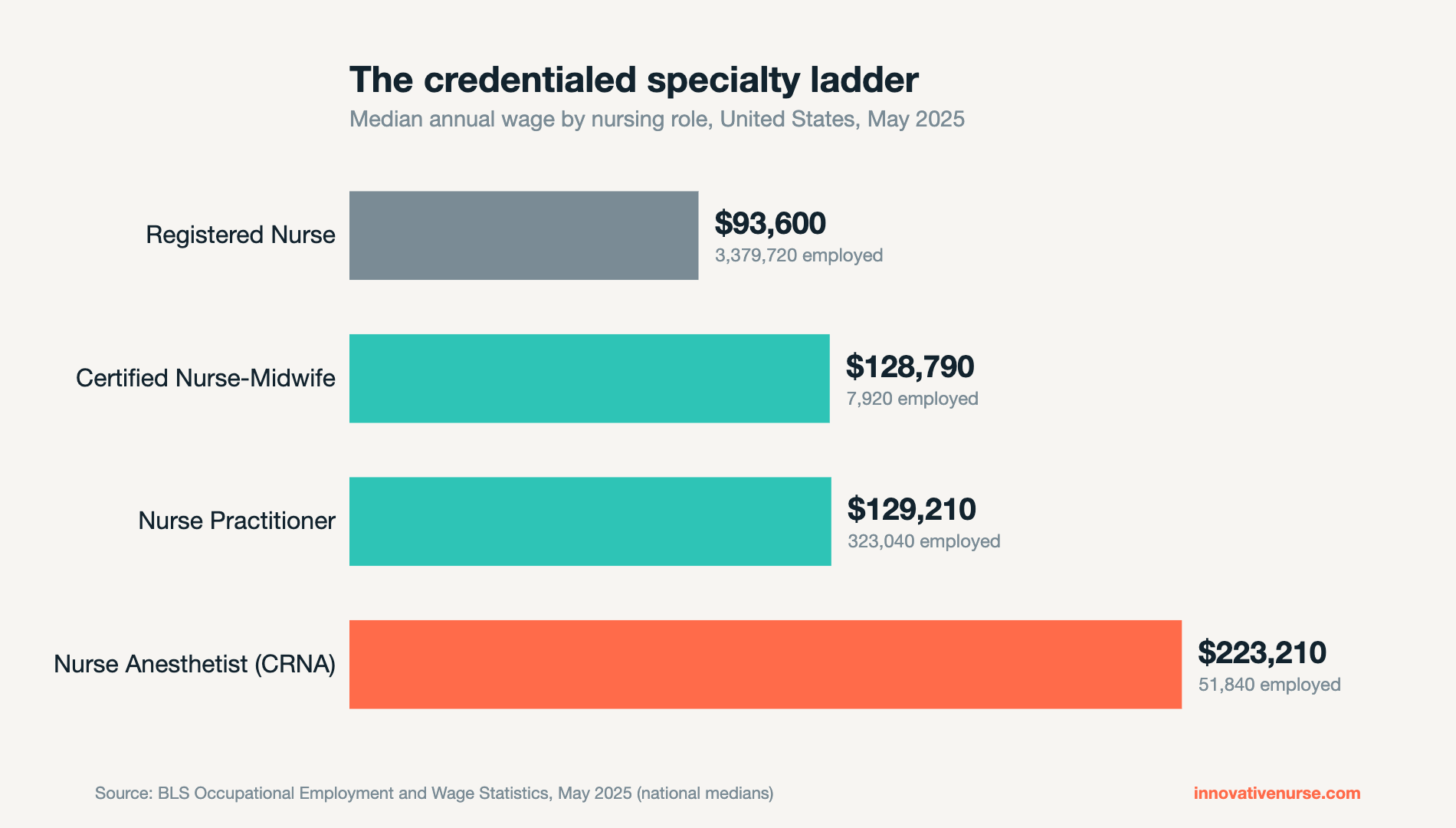
Read that last one again. The median CRNA out-earns the median RN by roughly $130,000 a year. That’s not a differential. That’s a second RN salary stacked on top of yours.
Scarcity is doing the work: about 3.4 million RNs, 323,000 NPs, and only around 52,000 CRNAs. The market pays for the rungs fewer people climb.
What moves bedside pay, since BLS won’t tell you
At the bedside, specialty pay differences are real but they travel in disguise. They show up as:
- Differentials, not base rate. Nights, weekends, charge, on-call. Procedural and critical-care units typically have more differential surface area than clinic roles. Two nurses with the same base rate can be $15,000 apart in W-2 income on differentials alone.
- Setting. Hospital-employed RNs out-earn most other settings, and within hospitals, market-scarce skills (OR circulating and scrubbing, cath lab, CVICU) command hiring bonuses and retention pay that never appear in “average RN salary” statistics.
- Certification premiums. Many systems pay a flat annual bump or hourly add for CCRN, CNOR, CEN, and similar credentials, and even where they don’t, the cert is what unlocks the higher-paying transfer.
- Exit velocity. Some specialties feed directly into the high-paying next rungs. ICU experience is the standard prerequisite for CRNA school. L&D feeds nurse-midwifery. ER and ICU feed flight, informatics vendors love nurses who lived in the EHR, and the OR feeds device rep and management tracks nurses rarely price in at age 24.
That last one is the sleeper. When you pick a specialty, you’re not just picking this year’s paycheck. You’re picking which doors are cheap to open later.
The specialty-switch worksheet
Thinking about a move? Run the numbers before you run the transfer paperwork. For the specialty you’re in and the one you’re eyeing:
- Base hourly rate, from an actual posting or a colleague, not a national average.
- Realistic differential income: which shifts you’d actually work, times the posted differential, times 2,080 hours’ worth of your real schedule.
- Certification pay: what your system adds for the specialty cert, plus exam and renewal costs on the other side of the ledger.
- Training cost of the switch: orientation weeks at base pay, any pay-step reset, any contract commitment.
- Five-year exit value: what the specialty makes you eligible for (CRNA school, NP tracks, non-bedside roles) and what those pay. A specialty that pays $2 an hour less today but feeds a $220,000 credential is not a pay cut.
And one script, because asking about money at the bedside is still weirdly taboo. To the recruiter or manager of the unit you’re eyeing: “Can you walk me through total compensation for this role, including base, shift differentials, certification pay, and any specialty premium? I want to compare it accurately to what I earn now.” That’s the whole script. It’s a normal question. Anyone who bristles at it has told you something useful about the unit.
If the math turns into a bigger question, whether to stay in your specialty, switch, or leave the bedside entirely, that’s exactly what the Stay-or-Pivot calculator is built for. Put your real numbers in it and let the spreadsheet argue with your gut.
If the switch you’re weighing runs through school, your employer may be quietly willing to pay for part of it: see the nurse’s guide to maximizing tuition reimbursement.
The takeaway
Every specialty PSA in that megathread was a nurse telling strangers the true cost of their corner of the profession. Believe them. Then do what almost nobody in the thread did: put a number next to the cost. Your specialty is a salary decision. You’re allowed to remake it.
Methodology & sources
Wage figures are from the U.S. Bureau of Labor Statistics, Occupational Employment and Wage Statistics (OEWS), May 2025 release (published April 2026): Registered Nurses (29-1141), Nurse Practitioners (29-1171), Nurse Anesthetists (29-1151), Nurse Midwives (29-1161), national medians and means, accessed August 2026. Employment counts are from the same release. Advanced-practice sub-specialty medians referenced from the allnurses 2026 Nursing Salary Report (updated July 2026), which combines BLS and CareerOneStop data.
Caveats: BLS does not publish bedside RN wages by clinical specialty; bedside comparisons in this piece describe pay mechanics (differentials, setting, certification premiums) rather than federal statistics. Means are not offers; national figures hide state and metro spread. Averages reflect all experience levels. Differential and certification-pay examples vary by employer and contract.
EDITOR NOTES (delete before publish): Reddit signal: r/nursing week of Aug 10-17, 2026 — specialty PSA megathread (750+ comments), characterized in aggregate, nothing quoted. Deliberately shallow on cert ROI to leave room for a standalone CCRN ROI piece.