
You earned this moment. Now protect it.
Somewhere right now, a new grad is refreshing their banking app, waiting for their first real RN deposit to land. Maybe that’s you. You survived nursing school on ramen and frayed ends of sanity, passed the NCLEX, and now a number is about to hit your account that’s bigger than anything you’ve seen from two weeks of work.
Some nurses cry when they see it. That’s not dramatic. That’s earned. If you came from a situation of economic uncertainty, from food insecurity, from a $13/hour job that never covered the bills, that first paycheck isn’t just money. It’s proof the plan worked.
So let’s start here: the feeling is real, and you should feel it fully.
Then let’s talk about the trap that’s waiting on the other side of it.
The vent, validated
Ask a room full of experienced nurses whether that paycheck changed their lives and you’ll hear two answers, usually from the same person:
“Absolutely. Nursing got me out of poverty.”
“And I watched half of it disappear before I understood where it was going.”
The pattern repeats everywhere nurses gather. The nurse who doubled her income and somehow still lived paycheck to paycheck two years later. The new grad who celebrated with a $700/month car payment before finishing orientation. The veteran whose one-sentence advice to every new grad is the same: watch out for lifestyle creep. It happens to all of us until you recalibrate.
They’re not being buzzkills. They’re describing the single most predictable financial event in a nurse’s career, and the numbers back them up. Roughly 36% of Americans earning over $100,000 a year live paycheck to paycheck. A six-figure income does not protect you from a five-figure spending habit. Nothing does, except a system.
The reframe: this isn’t a paycheck moment, it’s a decision moment
Here’s the status quo script: get the job, get the check, upgrade the car, upgrade the apartment, wonder in three years why you feel trapped in a job you’ve started to resent.
Never just the status quo. Let’s rewrite it.
Your first year of RN income is the highest-leverage financial year of your career. Not because it’s your biggest check (it isn’t, yet), but because your expenses are still calibrated to student life. Every month you hold your spending at student level while earning nurse money, the gap between the two is pure leverage. Leverage to kill debt. Leverage to build the escape fund that lets you say no to a toxic unit. Leverage to make your next career move from a position of strength instead of desperation.
Lifestyle creep isn’t a character flaw. It’s just what happens when income rises and no decision gets made. So make the decision this week, before the second check lands.
First, know your real number
“RN money” means wildly different things depending on your zip code.
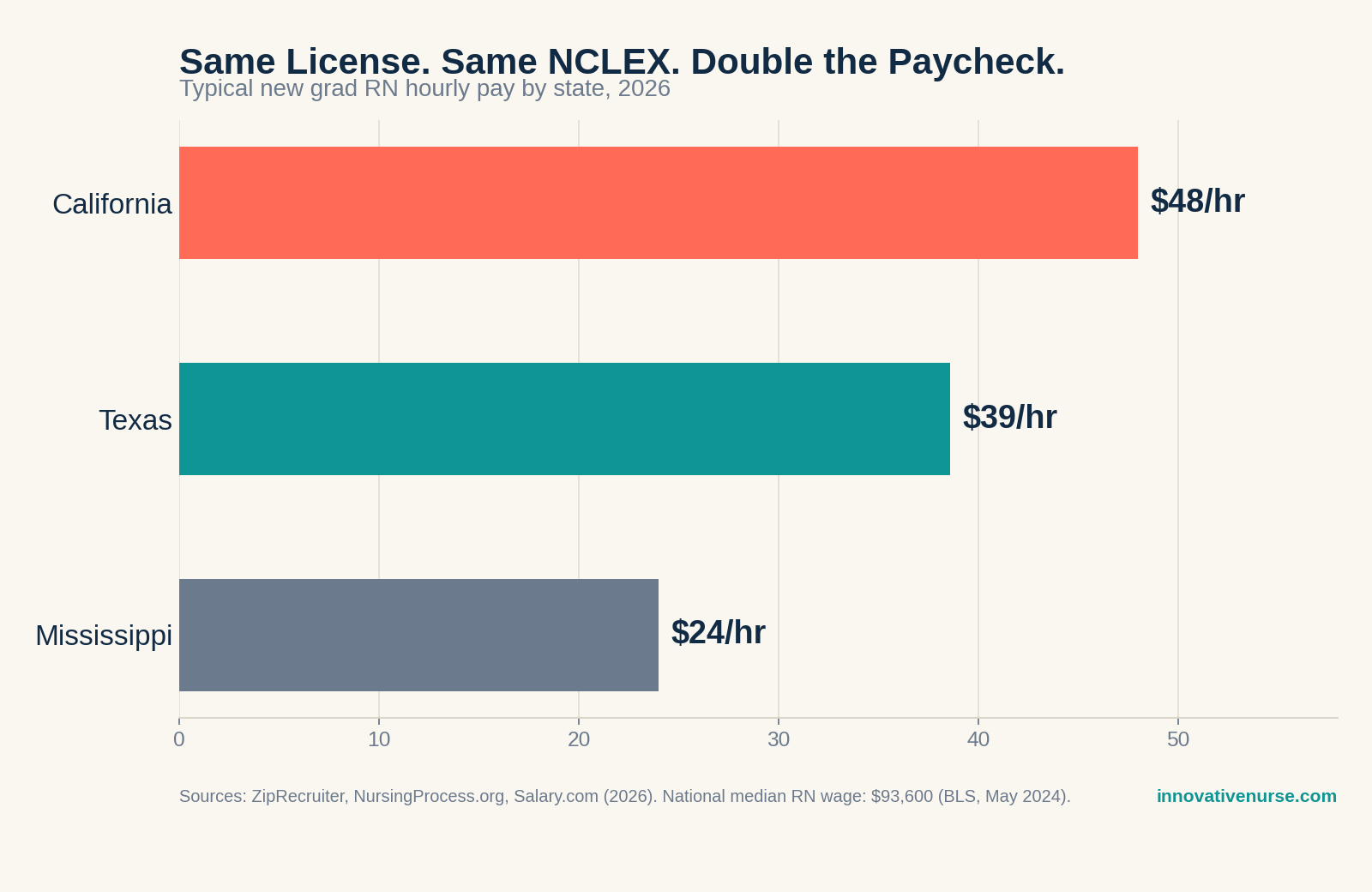
You will see that these numbers will have some variability in your own research, but the national median RN wage is $93,600 a year (about $45 an hour), per the Bureau of Labor Statistics. But new grads start well below the median, and geography swings the range hard: new grad pay runs from roughly $24/hour in Mississippi to $38 in Texas to $48 in California. Same license. Same NCLEX. Double the paycheck.
Before you move for money, run the cost-of-living math. California pays the highest nominal RN wage in the country at $72.25/hour (all experience levels), but adjusted for cost of living that’s worth about $50.77. A nurse moving from Indiana to California closes a $29/hour paper gap to under $4/hour of real purchasing power. The paycheck is not the prize. The gap between your paycheck and your cost of living is the prize.
The First Paycheck Playbook
Six moves, in order. Most take under 30 minutes each.
1. Capture the full employer match, starting with paycheck one.
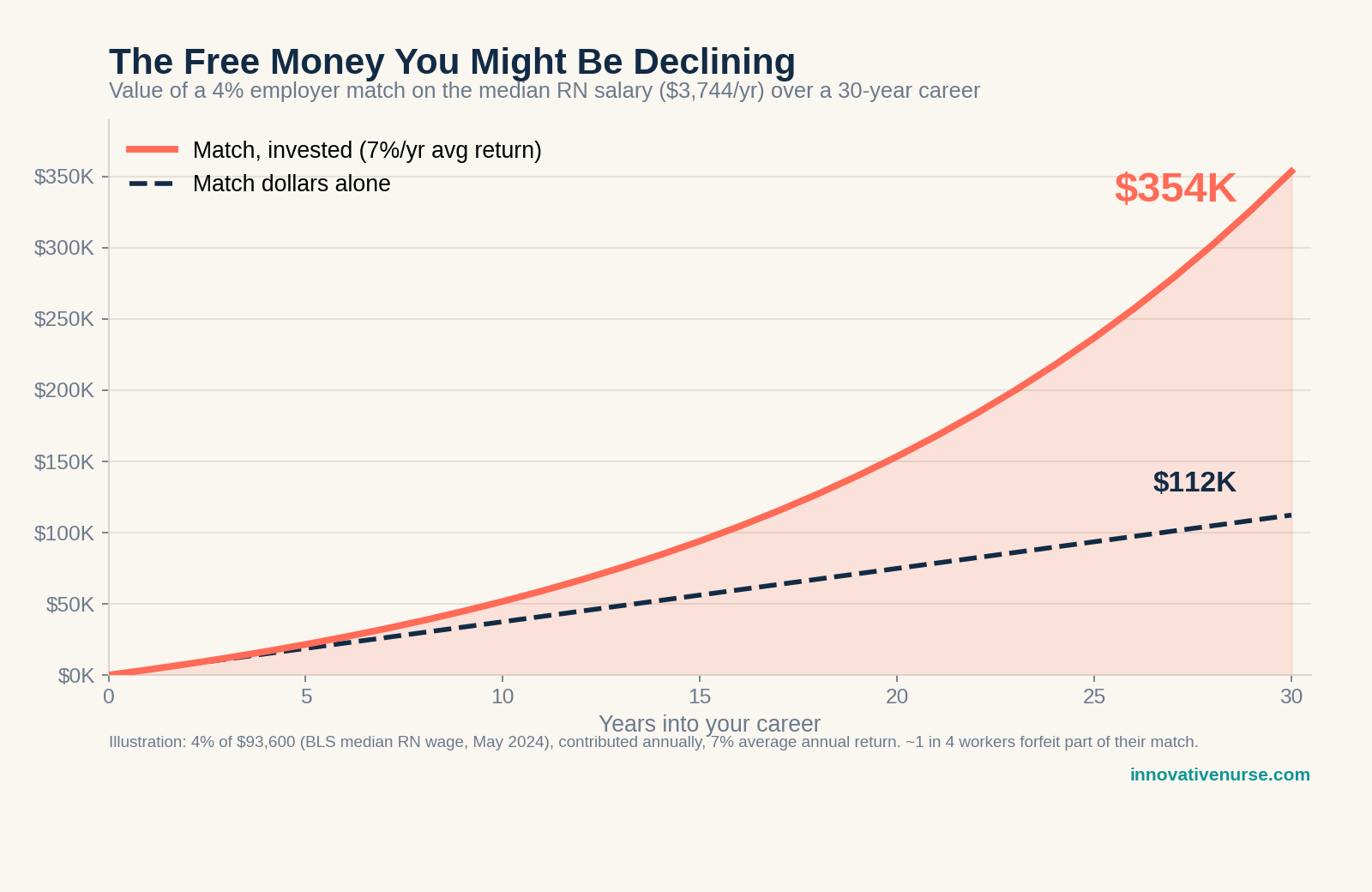
If your hospital matches 401(k)/403(b) contributions, contribute at least enough to get every matching dollar. This is not an optional nice-to-have; it’s part of your compensation, and roughly 1 in 4 workers forfeit some of it by under-contributing. The math is brutal: a nurse at the median wage skipping a 4% match walks away from roughly $3,700 a year. Invested over a 30-year career at 7% average returns, that compounds to over $350,000. That’s a paid-off house, declined by default.
2. Automate before you see it.
The veterans all say versions of the same thing: money you never see is money you never miss. Set your retirement contribution and a 10–20% automatic transfer to a separate high-yield savings account to trigger on payday. Your checking account balance is your spending speed limit, so set the limit before the creep does.
3. Go scorched earth on high-interest debt.
The average BSN grad carries roughly $24,000–$29,000 in student loans, and many new grads add credit card debt from the no-income school years. Attack anything above ~7% interest like it’s a critical lab value, because it is. Every month of student-level living while earning nurse money can clear thousands. Nurses have wiped out $20K in under a year this way. It’s not deprivation. It’s a short sprint that buys permanent freedom.
4. Build the “walk-away fund.”
Six months of bare-bones expenses in savings isn’t just an emergency fund. For a nurse, it’s negotiating power. It’s the difference between enduring an unsafe unit because you’re trapped and leaving because you can. Career leverage starts with a bank balance that lets you say no.
5. Delay the two big upgrades for 12 months.
The car and the apartment. These are the two purchases that lock in lifestyle creep, because they’re contracts: you can skip a restaurant next month, but you can’t skip a lease or a loan. One year. Drive the beater one more year. Then upgrade deliberately, with cash flow you’ve already proven you don’t need.
6. Then spend, on purpose.
This is not a frugality sermon. Buy the good bread. Take the trip. Fix the car the day it breaks without checking your balance first. That’s the whole point of the leverage you’re building. The rule isn’t “don’t spend.” The rule is: decide first, spend second. Creep is spending that nobody decided.
The one-year checkpoint
Twelve months in, ask yourself three questions:
- Is my savings rate at least 15% (including the match)?
- Is my high-interest debt gone or on a clear kill schedule?
- Could I survive six months without this specific job?
Three yeses and you’ve done what most earners at any income level never do, and you’ve earned every upgrade you now choose to make. Any nos, and you know exactly which lever to pull next.
And if a year in you’re realizing the problem isn’t your budget but the bedside, that’s not a failure. That’s data. Run your numbers through the Stay-or-Pivot Calculator and find out what your license is actually worth in the roles nobody told you about in nursing school.
You worked too hard for that first paycheck to let it quietly disappear. Make it the first move in a bigger game.
Want the scripts, the numbers, and the next move every week? Join the Career Leverage Newsletter, because your license is worth more than the status quo.
Sources
- U.S. Bureau of Labor Statistics, Occupational Outlook Handbook: Registered Nurses: median RN wage $93,600 (May 2024)
- BLS Occupational Employment and Wage Statistics, state-level data (May 2025) via Nurse.org state salary analysis: California nominal $72.25/hr, cost-of-living adjustments, Indiana comparison
- ZipRecruiter: New Grad Nurse Salary and NursingProcess.org state hourly data: new grad regional range
- Fidelity: Average 401(k) match and Forbes: 401k savers leaving money on the table: ~1 in 4 workers miss full match; ~4.5% average match
- NerdWallet: Average Nursing Student Debt: BSN debt averages
- Empower: Lifestyle creep and Debt.org 2024 survey: 36% of $100K+ earners live paycheck to paycheck