
Following up on some of the videos you may have seen, a nurse looks into the camera and says she left the bedside, and the comments fill up with the same question: why? Nobody in those comments asks the other question. What did staying cost that nurse?
If you’re a nurse who’s been quietly doing that math at 3 a.m., this post may be for you. This isn’t about being dramatic. You’re not weak. You’re just noticing that the price of your job went up while the paycheck didn’t. That’s a business problem, and business problems need decisions.
Stop asking “Should I quit?” Ask “What’s this costing me?”
“Should I quit?” is a feelings question, and feelings change by shift. “What does staying cost, and what does leaving cost?” is a numbers question. You can answer it on paper. Once you can see both columns, the choice usually becomes more clear, and sometimes the answer isn’t quitting at all. It’s a transfer, a raise (if you can get it), a schedule change, or a 90-day plan to leave on your terms.
The cost of staying: five lines
If you’re the type to write things down, then grab a pen. Write a number next to each line. Estimates are fine. Be honest, not generous.
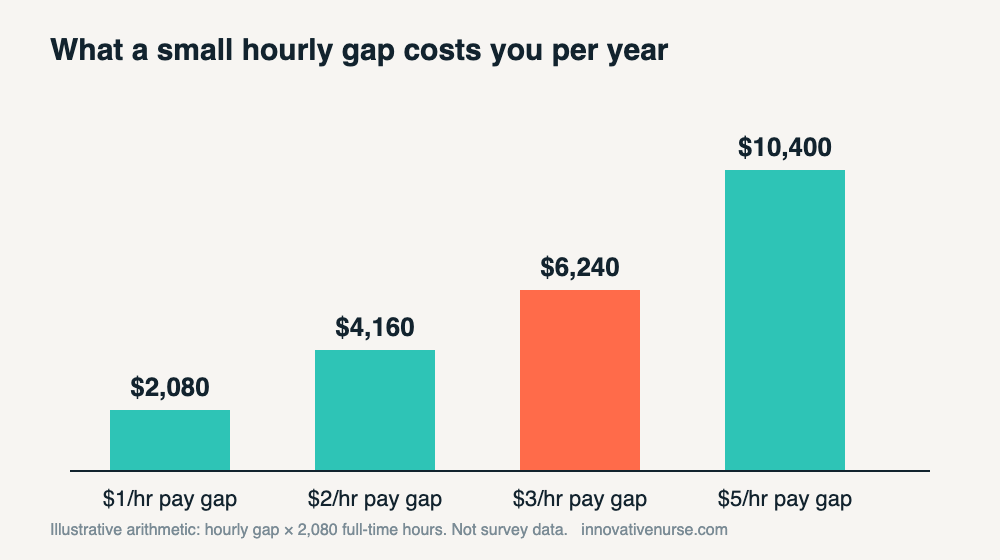
- Pay gap. Look up what your role pays at other employers near you (the BLS wage data for registered nurses is a solid starting benchmark), then subtract your current rate. Use your hourly rate times 2,080 hours for a full-time year. A $3/hr gap is about $6,240 a year.
- Unpaid work. Count the minutes a week you stay past shift for charting, skip breaks, or cover tasks that used to belong to someone else. Multiply by your hourly rate and 50 weeks. Thirty unpaid minutes a shift, three shifts a week, at $40/hr is roughly $3,000 a year.
- Benefits you’re not using or can’t count on. Tuition help, retirement match, PTO you can’t actually take. If you can’t use it, it isn’t worth what the benefits sheet says, which I need to emphasize the importance of at least being able to take advantage of an employer match in your retirement account. If this is the case, this isn’t a tomorrow problem.
- Recovery costs. Not being able to invest in your own health, nutritionally and exercise. Maybe you’re doing more take-out because you’re wiped, extra childcare costs on long days, the sick days you burn through. Add up one typical month and multiply by 12.
- Time you won’t get back. This one doesn’t have a dollar figure, so give it a score from 1 to 10: how much of your health, relationships and weekends is this job taking?
The cost of leaving: four lines
Leaving has a price tag too, and pretending it doesn’t is how people jump without a net.
- Income gap. How many weeks between jobs, and what’s your weekly take-home? Plan for longer than you hope.
- Benefits you’d lose. Health insurance coverage dates, retirement vesting, any sign-on or tuition clawbacks. Read your agreement before you make a move.
- Reference risk. Make a list of people you work with, managers/leadership, and line up at least two people who will vouch for you. Our exit checklist walks through license, money and references step by step.
- Ramp-up cost. New orientation, new commute, new schedule, possibly a pay step reset. Price it into your decision.
How to read your two columns
Add each column. Then ask three questions.
- Is staying costing more per year than a few months of searching would? Then waiting is the expensive option.
- Is the problem the employer, the unit, or the bedside itself? Different problems get different fixes.
- Do you have six months of cushion, or do you need to line up the next job before you give notice?
Want the arithmetic done for you? Run your own numbers through the Stay-or-Pivot calculator and see where you land.
A script for the conversation before you leave
If staying is still on the table, make your manager price it too. Try this:
“I want to stay, and I’m weighing an offer. Here’s what’s changed in my role over the past two years. Here’s what comparable roles pay in our area. What can we do on my current rate, schedule or scope to keep me here?”
Say it calmly, bring your numbers, and ask for a response by a date. If the answer is a pizza party, you have your answer. And if the decision gets made for you, start with our 30-day plan for getting fired before you panic.
You’re allowed to leave. You’re also allowed to stay on purpose.
Some nurses run the numbers and decide to stay, with a raise, a new unit, or an exit date they control. Others see the math and go. Either way, you stop drifting. That’s the whole point that should never be just the status quo.
If you want one practical move like this in your inbox each week? Join the Career Leverage Newsletter.
Methodology and caveats
- Dollar examples are illustrative arithmetic (rate times hours), not survey results.
- Benchmark local pay with BLS Occupational Employment and Wage Statistics (OEWS) for your area and occupation, and see the OEWS page for registered nurses (29-1141), plus real postings. Check the data year before you quote it. Means are not offers.
- Check your state board of nursing and your employment agreement before resigning. This is not legal or financial advice.