
You’ve seen the posts. A job posting says $4,000 a week. An Instagram reel says “I made six figures in 24 weeks.” Meanwhile you’re at the bedside on your third 12 in a row, doing the math on what your own hospital pays. Wanting that number isn’t greedy. It’s rational.
But a weekly rate isn’t a paycheck, and a paycheck isn’t wealth. Before you sign anything, you need to know what’s inside that number, what’s missing from it, and whether the offer beats staying put. Here’s how to read it.
Step 1: Split the headline into three buckets
Almost every travel package is built from the same pieces, and they’re taxed differently.
- Taxable hourly pay. This is your actual wage. Federal and state taxes come out of it like any other W-2 job.
- Lodging stipend. Meant to offset the cost of a second place to live. Generally tax-free only if you qualify for a tax home (more below).
- Meals and incidentals. Same idea, and same condition. The federal standard is $68 a day for travel on or after October 1, 2026, and it varies by city. Look yours up on the GSA per diem lookup.
Ask the recruiter for the number in each bucket, in writing. If they only quote the total, that’s your first red flag.
Step 2: Run the annual math, not the weekly math
Here’s an illustration, not a real offer. Say the headline is $4,000 a week, split as $2,000 taxable, $1,500 lodging and $500 meals.
The quick math multiplies by 52: $208,000. The reality is different. Contracts are usually 13 weeks, and gaps between them are unpaid. If you work three contracts in a year, that’s 39 paid weeks:
- 39 weeks x $4,000 = $156,000 in total package
- Taxable wages: 39 x $2,000 = $78,000
- Stipends: 39 x $2,000 = $78,000, which you spend on housing and food at the assignment
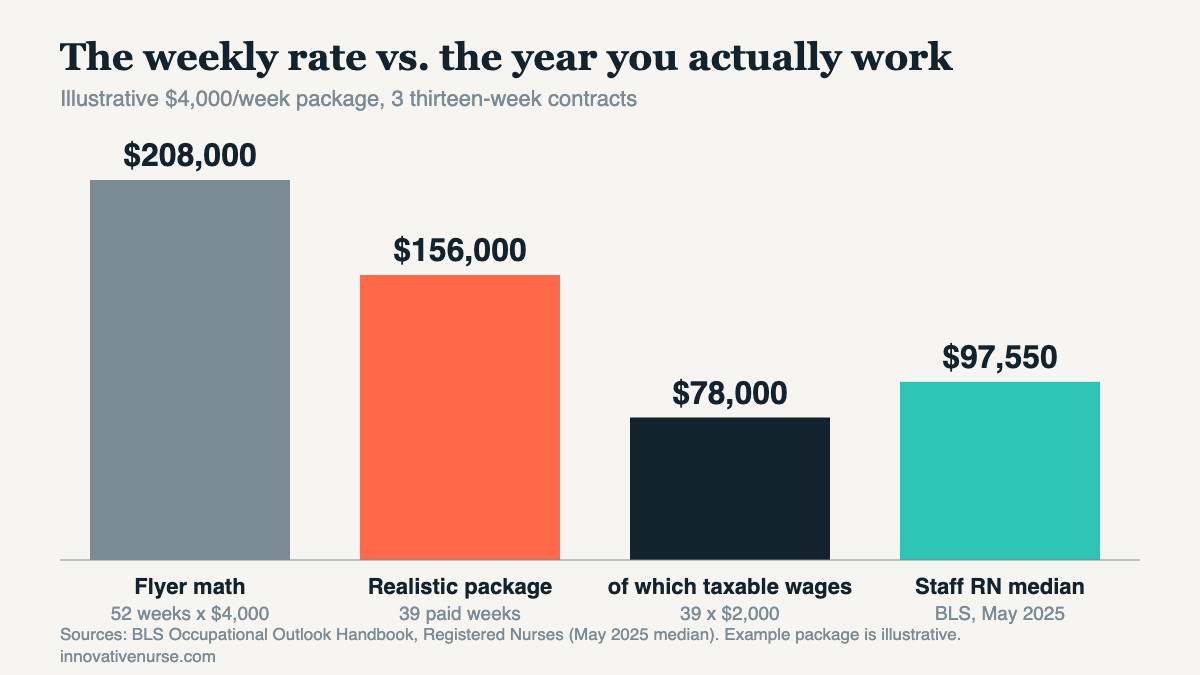
Now compare. The BLS median for registered nurses is $97,550 a year ($46.90 an hour) as of May 2025, and a staff job typically includes paid time off, employer-covered health insurance and a retirement match. Subtract what you’ll pay for your own insurance, the cost of the gaps and travel to each assignment. The gap between “$156,000” and “$97,550” is real, but it’s much smaller than the flyer suggests, and it shrinks further if you can’t keep the contracts stacked.
Step 3: Understand the tax home rule
Tax-free stipends depend on having a tax home: a permanent place you maintain and pay for while you work elsewhere. Generally that means paying real living costs in both places, keeping ties to your home area, and not working in one location long enough that the IRS treats it as your new home (commonly cited as a one-year limit). If you don’t qualify, stipends can be treated as taxable wages, and that can mean back taxes. Read IRS Publication 463 and talk to a tax professional who works with traveling nurses before you sign. This isn’t tax advice.
Step 4: The contract checklist
- Guaranteed hours per week (36? 48?) and what happens if the facility cancels shifts
- Cancellation policy in both directions, and any penalty if you cancel
- Taxable rate, lodging and M&IE written out separately
- Overtime rate and how it’s calculated
- Health insurance start date and weekly cost, and whether there’s a gap before it begins
- Float, call and holiday expectations
- Reimbursements: license fees, travel, orientation hours (paid or unpaid)
- Extension terms and whether the rate changes
- Whether you’d be assigned to the unit you were promised
Step 5: Scripts for your recruiter
“Can you send me the weekly breakdown: taxable hourly rate, lodging stipend and meals stipend, plus the guaranteed hours?”
“If the facility cancels my shifts, what do I get paid for that week?”
“What’s my weekly cost for health insurance, and when does coverage start?”
“Is the rate you’re quoting the same one on the contract I’ll sign?”
The decision
Travel nursing isn’t a scam and it isn’t a shortcut. For some nurses, it’s the best lever they’ll ever pull. For others, it’s a lot of paperwork to earn the same money with less stability. The question isn’t “How much per week?” It’s “How much do I keep after taxes, gaps, insurance and the life I’d have to rearrange?”
Plug your real numbers into the Stay-or-Pivot calculator and see where travel actually lands against staying put.
Methodology & sources
- U.S. Bureau of Labor Statistics, Occupational Outlook Handbook: Registered Nurses (May 2025 median pay)
- U.S. General Services Administration, per diem rates (FY 2027 standard CONUS M&IE of $68, effective October 1, 2026)
- IRS Publication 463, Travel, Gift, and Car Expenses
Caveats: the $4,000 example is illustrative, not a quote. Standard federal per diem is a benchmark, and agency stipends vary by market. Medians are not offers. Tax treatment depends on your individual facts.