
This headline just crossed my feed and I figured this was coming, but not this soon. I’m not one to panic over a headline because context matters. It’s all over every nursing forum: a major New York hospital is cutting a dozen nursing jobs and handing the work to AI software. One of those nurses has been there 39 years. She got 45 days’ notice.
If your confused by this, or your stomach dropped, that’s a normal reaction. Nobody spends years earning a license to watch a software vendor walk off with the job. So let’s take the fear seriously, and then let’s take it apart. Because “AI is coming for nursing” is not a plan. It’s a panic. And panic is the one career strategy that never pays.
What actually happened
Here’s the short version, so we’re working from facts instead letting emotion drive this bus.
According to the New York State Nurses Association, Montefiore Medical Center in the Bronx sent termination notices to 12 utilization review nurses across its three campuses in late May 2026, with the positions set to end July 12, about a 45-day window. The union says their work is shifting to AI-powered software from a company called Datavant.
The timing is what made this explode. These are the same nurses who came off a 41-day strike that won a three-year contract with a first of its kind AI protection language, which states: if AI causes a “diminishment” of union jobs, management has to meet with the union first. NYSNA says that meeting never happened and filed a class-action grievance on June 1st. Montefiore calls the union’s claims inaccurate and misleading, and describes the change as a nonclinical program that helps with paperwork. The dispute is now in the grievance process — nothing has been proven either way.
Sources worth your time: Nurse.org’s breakdown, NYSNA’s statement, and Gothamist’s reporting.
Read the detail everyone is skipping
The 12 nurses are utilization review nurses. Their job is reviewing charts and justifying care to insurance companies. It’s essential work — their clinical judgment is what pushes back when an insurer wants to deny coverage. But notice what it is structurally: documentation heavy, pattern based, done at a desk, measured in throughput.
That is exactly the profile of work AI vendors target first. Not because those nurses matter less, but because their work product is text, and text is what this generation of AI is built to process.
Nobody bought software to start IVs, catch the subtle change in a post-op patient, or talk a scared family through a 2 a.m. decision. That’s not on the roadmap, and anyone who tells you otherwise is selling something.
So the honest takeaway is neither “nursing is doomed” nor “this doesn’t affect me.” It’s this: the more of your role that lives in documentation and protocol, the more exposed it is. The more of it that lives in assessment, judgment, and human coordination, the safer it is. That’s the axis that matters now — and unlike the headlines, it’s one you can actually move on.
Stop asking “will AI take my job?” There’s a better ask.
“Will AI take my job?” is a question you can’t answer and can’t act on. Trade it for three you can.
1. How exposed is my current role?
Run a ten-minute audit of your last full shift:
- What share of your time was chart review, documentation, or data entry?
- What share was hands-on assessment, procedures, and patient interaction?
- What share was judgment calls: escalating, catching errors, pushing back?
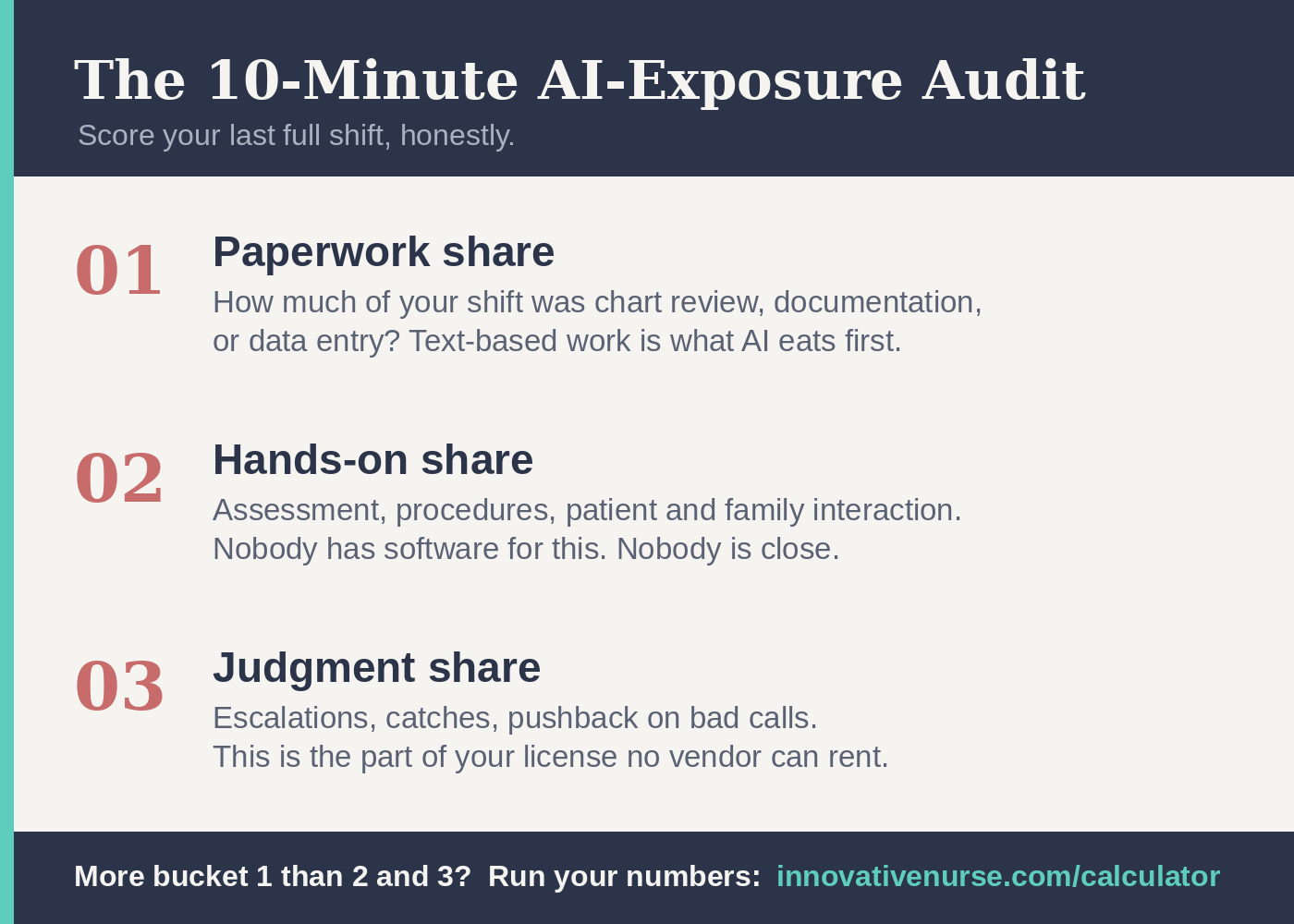
There’s no magic threshold. But if the first bucket dominates your week, you’re in a role category vendors are actively pitching to your hospital, and you want to know that before your CNO does.
2. What does my contract actually say?
The Montefiore fight is being waged on one clause. Whether that AI-diminishment language holds is going to shape bargaining everywhere. So find out where you stand. Ask your union rep, or HR if you’re non-union:
“Does our current contract or policy include any language about AI or automation affecting jobs? If my role were restructured around new technology, what notice and consultation am I owed?”
That’s a two-minute email. Send it this week. If the answer is “nothing,” that’s likely some news that jumpstarts your bargaining agenda for the next contract.
3. Am I positioned to profit from the shift instead of losing to it?
Every hospital rolling out AI tools needs nurses who understand both the clinical work and the technology: informatics nurses, clinical analysts, super-users, documentation integrity specialists. Someone is going to configure, audit, and challenge these systems. A nurse who can do that is harder to replace than the software, and typically better paid than the bedside.
The three moves
- Audit your exposure — ten minutes, three buckets, be honest about the mix.
- Get your contract answer in writing — use the script above.
- Pick one leverage skill this quarter — informatics certificate, super-user role on the next rollout, or a quality/documentation integrity project you can put on a resume.
The nurses at Montefiore didn’t get a vote on the timing. You, right now, still do. That’s the entire difference between reacting to this story and being ready for the next one.
Wondering whether your current role is worth defending or worth leaving? Run it through the Stay-or-Pivot calculator — ten minutes, real numbers, no wishful thinking. And if you want the next shift in nursing to land in your inbox before it lands on your unit, the Career Leverage Newsletter is free.
Never just the status quo.